Review: York Early Music Festival Online, July 9, Iestyn Davies & Elizabeth Kenny; July 10, Matthew Wadsworth; Steven Devine; Richard Boothby

How it looked when watching from home: Lutenist Elizabeth Kenny and countertenor Iestyn Davies performing at the National Centre for Early Music, York, in Thursday’s live streamed concert

IF, like me, you enjoy the arts and sport, you will have rejoiced in a bumper week. First, we had the

Government giving an unprecedented £1.57 billion fillip to the arts, thereby drawing a graceless murmur of thanks from the generally Tory-hating lefties that populate the arts sector.

Then, the cricket season resumed, to the familiar sound of England wickets tumbling. Finally, one of the world’s top three early music festivals, has returned, albeit online and in much-shortened form.

But we must be grateful for small mercies these days. Here we had a bunch of stalwart pros who refused to roll over and succumb to a mere virus. All had travelled to York and recorded musical offerings on the theme of Method and Madness; eight events – three of them talks – over three days.

First out of the blocks, on July 9, was York’s own countertenor Iestyn Davies, partnered by lutenist Elizabeth Kenny, a world-class pairing if ever there were. Their programme was devoted to that master of melancholy, John Dowland. If you want to be modern about it, you can class melancholia as an aspect of mental health. The Elizabethans called it a disease but made light of it too.

Melancholy was something to be enjoyed, even revelled in, and not excluding self-pity. We all know the feeling. Melancholy has been the counterpart in English song – though not the same – to the German Sehnsucht (yearning). Think of all those aching pastorals lamenting the passing of rural idylls, most of which were figments of the imagination anyway. We all enjoy a little angst.

We need not explore the many facets of Dowland’s melancholic psyche any further. Here we were reminded – by a letter he wrote from Nuremberg in 1595 – of his early exile, separated from the country, the queen and the family he loved by having to earn a living abroad, because his Catholic faith disqualified him from acceptance at court. Davies read this and other illuminating texts, mainly of the period, but including Leo Tolstoy and Rose Tremain too, to amplify Dowland’s many moods.

The music was not without technical shortcomings, not by the performers, but the technology: pictures that moved jerkily and occasional breaks in the sound. But a CD would not have been more satisfying.

It was a joy to get back to seeing live performers revelling in their art. Davies delivered reams of easy, liquid tone that underlined Dowland’s incomparable skill as a songwriter. His words were not especially clear, even with a text to hand, but that may have been due to insufficient ‘miking’.

Harpsichord player Steven Devine recording his 2020 York Early Music Festival concert at a deserted National Centre for Early Music in York

Kenny’s pluckings not merely supplied a rhythmic foundation. She improvised magically in her intros and in the space between verses (ritornellos); she also contributed several mood-lightening dances.

It was hard not to feel that we were experiencing Dowland’s songs exactly as they would have sounded 400 years ago, not in a dusty, ancient way, but as a living art as relevant today as Shakespeare. We may remember that Dowland’s Third and Last Booke of Songs was published in 1603, the same year as Hamlet – that arch-melancholic – was first printed.

The last word goes to Dowland himself, from his dedication to Lachrimae, a book of dances: “Pleasant are the tears which music weeps”. Indeed.

Matthew Wadsworth continued the Dowland theme on lute and theorbo at lunchtime on Friday, alongside the music of other contemporaries. There was as a wide a range of moods here as there had been in the songs, with bolder declamation from the long-necked theorbo with its deeper resonance.

Wadsworth flowed fluently over the strings and the close camera work emphasised the music’s intimacy.

During the afternoon, Steven Devine played the second half of Book 1 of Bach’s Well-Tempered Clavier, the preludes and fugues Nos 13-24, on a two-manual Michael Johnson harpsichord built in Fontmell Magna in 1997. He proved a deft exponent, though on such a bright-toned instrument he might not have coupled the manuals quite so frequently. But at least we were able to marvel anew at the breadth of Bach’s ingenuity.

The evening brought in Richard Boothby playing a lyra viol, the smallest of the three kinds of bass viol. He began both halves with music by Alfonso Ferrabosco the younger, an Englishman of Italian descent who was especially prominent at the Jacobean court. Pairs of dances amply contrasted the gentler alman with the altogether friskier coranto, with its skipping rhythms.

Similar pairings from William Lawes and John Jenkins led into two brilliantly virtuosic variations by the little-known William Corkine and ‘divisions’ (variations) on Dowland’s famous Lachrime melody. Boothby introduced his music, which made the whole presentation much more personal.

We may be grateful to all these musicians for their labours in front of an unseen audience. The festival concluded with the ace choral group Stile Antico on Saturday evening. Watch this space for the review.

Review by Martin Dreyer

NCEM goes online in May with inspirational archival recordings and fancy footwork

Palisander: Watch out for spiders in all that foliage

THE National Centre for Early Music, York, will continue to reach out from behind closed doors to provide inspirational music online with a series of concerts throughout May.

Confirmed for next month are Palisander, Beware The Spider!, on Saturday (May 2); Rumorum, Medieval Music for voices and instruments, May 16, and European Union Baroque Orchestra, Handel & Bach, May 30, all starting at 1pm.

To view these concerts for free, follow https://www.facebook.com/yorkearlymusic/ or log on to the NCEM website, ncem.co.uk, where you also can find details of the Cuppa And A Chorus community singing sessions, now on Zoom, plus other NCEM news and more concert footage.

Palisander’s fancy footwork

In Beware The Spider!, first performed at the NCEM in March 2019, the young recorder quartet explore the Tarantella, the effects of a venomous spider bite, and the curious world of folk medicine. 

Fast moving and fun, with some fancy footwork to boot, the Palisander programme combined music by Vivaldi and many others with an entertaining narrative.

Like Palisander, Rumorum first played Medieval Music for voices and instruments at the NCEM in March 2019. These 12th to 15th century music specialists turn back the clock to the time of Medieval Europe when musicians travelled across the continent, gathering stories, sharing knowledge of love, pain and exile.

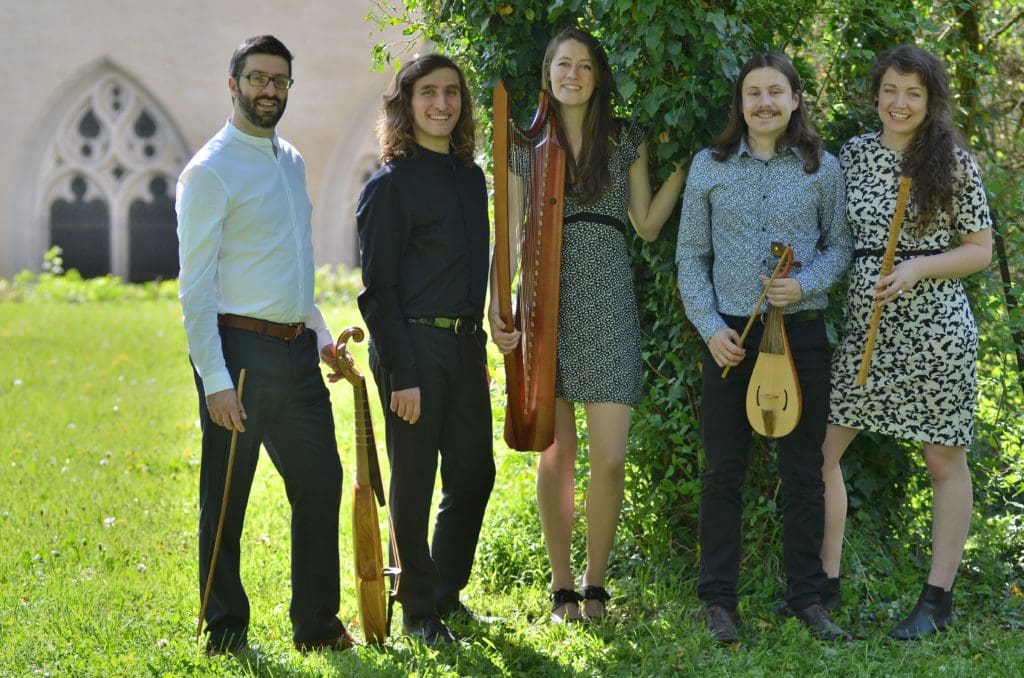
Rumorum: Rebec,, harp, flute and voice ensemble

This youthful ensemble formed while studying medieval performance at the Schola Cantorum Basiliensis in Switzerland and took York classical audiences by storm when winning the York Early Music Festival Friends’ Prize in the 2017 festival competition.  “If you can’t quite visualise a rebec, harp, flute and voice ensemble, this is your chance,” says NCEM director Delma Tomlin.

European Union Baroque Orchestra’s concert recording dates from March 2017, led by director and harpsichordist Lars Ulrik Mortensen, who was joined that day by soloists Maria Keohane, soprano, Bojan Cicic, concertmaster,and Neven Lesage, oboe.

The concert was performed to celebrate Early Music Day 2017 on the birthday of JS Bach. “Entitled Betrayal And Betrothal, it features music by Bach and Handel and provides an exciting opportunity to hear this outstanding group again, presenting one of their last ever performances on stage,” says Delma.

“Keeping in touch with our audiences is so important to us in these difficult times,” says NCEM director Delma Tomlin

As an added bonus”, harpsichordist extraordinaire Steven Devine will “help you beat the blues” with Bach Bites – bite size chunks to inspire and uplift – every Wednesday evening at 6pm.

Delma says: “Keeping in touch with our audiences is so important to us in these difficult times and we’re delighted to be able to bring you this eclectic selection of archival recordings from concerts recorded over the past couple of years.

“We’re also continuing our Cuppa And A Chorus event, where people can meet regularly to sing in a relaxed environment. We’re now meeting virtually on Zoom, so even though we can’t be together, we can all try and stay in touch.” 

WHAT’S STILL ON: Never too late for Early Music Day as NCEM streams concerts from behind closed doors

Devine intervention: Steven Devine’s concert WILL still happen, streamed across Europe from York. Picture: Guy Carpenter

EARLY Music Day will go ahead at the National Centre for Early Music, York, tomorrow but behind closed doors.

“Our doors may be temporarily closed, in response to the Coronavirus pandemic, but we’ll still be celebrating Early Music Day and streaming our concerts all around Europe, so join us for two wonderful concerts this Saturday (March 21),” says director Delma Tomlin. “There will also be a selection of concerts available to enjoy online over the coming weeks.”

Tomorrow’s programme at the NCEM, St Margaret’s Church, Walmgate, begins with a 1pm concert by harpsichordist Steven Devine, performing the first in a series of Bach Preludes and Fugues, and ends with The Brabant Ensemble’s 6pm programme of A Monk’s Life: Music From The Cloisters, 1550-1620.

From The Cloisters, from the NCEM: The Brabant Ensemble still in concert tomorrow. Picture: Alain Le Bourdonnec

“Sublime choral music from the Renaissance performed by this Oxford ensemble offers the perfect end to a fabulous day of music,” says Delma.

“I am so grateful to our talented array of musicians who are determined that Early Music Day will still happen somehow and have agreed to perform behind closed doors.

“Even if you can’t be with us in person, we hope that you will join us for this day of music, a joyful celebration which normally takes place with our European partners and friends in beautiful venues.”

“Music has the power to uplift and inspire us all,” says NCEM director Delma Tomlin

Looking ahead, Delma says: “We are pausing our operations until the end of April and will be in contact with everyone who has booked to attend concerts that are due to take place within this period.

“We ask that you are patient with us during this difficult time and wait for us to contact you. Regular updates about future concerts and more concert footage will be posted on our website, ncem.co.uk, and via social media, so please keep checking.”

To watch Saturday’s concerts follow: https://www.facebook.com/yorkearlymusic/

“Music has the power to uplift and inspire us all and although our building may be closed, we will be sharing a selection of concerts from our archives online for us all to enjoy,” says Delma, on an upbeat final note.