REVIEW: Martin Dreyer’s verdict on York Early Music Festival, International Young Artists Competition 2026, National Centre for Early Music, York, July 11

The Lyons Mouth: Winners of the Main Prize and Friends of York Early Music Festival Prize at York Early Music Festival’s International Young Artists Competition. Picture: Charlie Kirkpatrick

THIS biennial competition, for ensembles of at least three members with an average age no more than 35, attracted 56 entries this year. Nine of these reached the final, three each from the Netherlands and Switzerland and one each from France, Israel and the United Kingdom.

Two featured a solo soprano and one consisted of six unaccompanied singers. The remaining six were purely instrumental. There were three trios, four quartets and two sextets.

So much for statistics. However, they suggest, quite accurately, that there was variety aplenty. Technical standards were extremely high, reflecting the professionalism of early music teaching across European conservatories these days. ’Twas not always so.

Ossian’s Dream: Joint winners of European Union Baroque Orchestra (EUBO) Development Trust Prize. Picture: Shelagh Bourke

Eleven criteria were listed as assessable by the international jury. Only one, however, touched on that indefinable X-factor that marks out a performer as destined for a serious career: presentation. It involves the kind of charisma that conveys a good deal more than merely the music itself and is intertwined with a performer’s personality. Inevitably this was much rarer here.

Each group was allotted 20 minutes to display its wares. The sextet Ossian’s Dream was distinctive in sticking largely to the 19th century, with the historical clarinet of Claudia Reyes Segovia at its centre. After a crisp, not to say dramatic, account of Mendelssohn’s First Walpurgisnacht overture, there was strong contrast in the slow movement of Weber’s Clarinet Quintet, whose jovial centre was much enhanced by the clarinet. The finale of Mendelssohn’s C minor Piano Trio was truly effervescent.

The stand-out player of the quartet I Mastricelli was Bianca Cucini, whose soprano gamba dominated their set. With her colleagues confined to bass gamba, cello and organ, colours were otherwise regularly dark. A Tobias Hume almain and a lively, cross-accented Recercada by Diego Ortíz were but warm-up acts for the increasingly vivid variations in the Diferencias on ‘La dama le demanda’, by Antonio de Cabezón, which featured riffs from all four players.
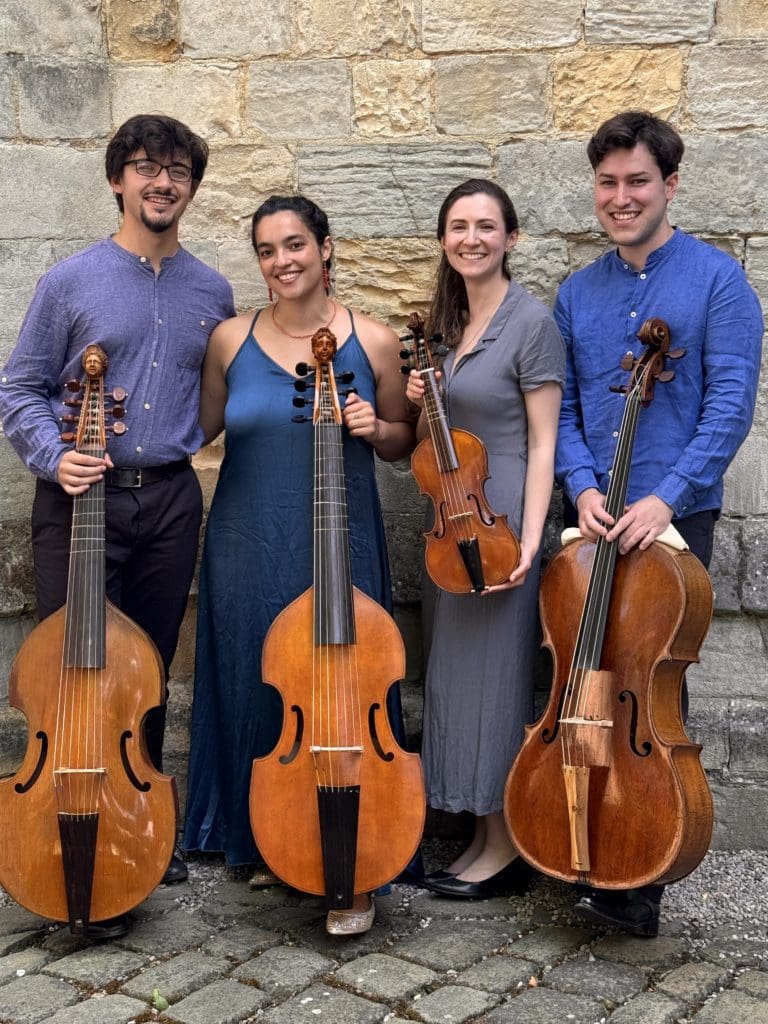
I Mastricelli, featuring jury prize for the most promising young artist winner Bianca Cucini. Picture: Charlie Kirkpatrick

Recorder, harpsichord and cello provided the underlay for soprano Liron Givona in the Nari Baroque Ensemble. She was fuller voiced than one might have expected in this repertory, but her tone was flexible even when slightly diffuse.

She trilled neatly alongside a sopranino recorder nightingale. The cellist was underpowered more than once here, but delivered some very rapid obbligato in a forceful little melodrama from a Pepusch cantata, ‘When Love’s Soft Passion’.

The French quartet La Mandorle – oboe, violin, cello and theorbo – focused on native composers from the generation just before Bach, all played without scores. Victoire Delnatte’s oboe was engagingly clean and full-bodied and Elodie Brzustowsk’s theorbo proved fluent.

Lagrime: Winners of the Cambridge Early Music Prize. Picture: Charlie Kirkpatrick

The ensemble was rhythmically alive in Clérambault’s La Félicité suite and equally idiomatic in a Robert de Visée suite, in whose Gigue the oboist briefly slapped rhythm on the cello. This group was unlucky not to be among the prizewinners. We shall certainly hear from them again.

Bianca Cucini reappeared in the Swiss trio Tra Noi, playing bass gamba and quinton (a descant viol) alongside recorder and harpsichord. A rather pallid Passacaglia by Andrea Falconieri nearly let them down, but ensemble remained taut in the same composer’s Ciaccona at a rapid tempo.

However it was Nicola Matteis’ Diverse Bizzarrie that showed how technically dazzling a chaconne can be in the right hands. Spearheaded by Silvia Berchtold’s recorder, Tra Noi took all its hurdles in their stride.

Tra Noi: Joint winner of the European Union Baroque Orchestra (EUBO) Development Trust Prize. Picture: Charlie Kirkpatrick

Handel and his Italian rivals, Porpora and Geminiani, all born within two years of each other, were the targets of Dutch quartet Il Parrasio, with a standard line-up of two violins, cello and harpsichord or organ. It was all very stylish but lacking in daring.

There was clarity and balance in a Sinfonia da Camera by Porpora, and a delicately phrased Allegro in Handel’s Op 5 No 1 trio sonata. Geminiani’s Andante affettuoso (The Enchanted Forest) lacked emotion. It was a case of nearly there, but not quite.

Another Dutch quartet, Quarterino, with Tomasso Simonetta Sandri’s flute replacing one of the violins, took a similar tack, this time with Charles Avison heard between Geminiani and Vivaldi. Avison’s two allegros in a G minor trio sonata were impressive, one a snappy fugue, the other with tight-knit accents. But Vivaldi’s trio sonata, RV84 in D, fell down on two counts, a garbled opening Allegro, taken too fast, and an oddly chromatic ending that failed to convince.

Bianca Cucini: Winner of the jury prize for the most promising young artist, who played with both I Mastricelli and Tra Noi at the International Young Artists Competition. Picture: Charlie Kirkpatrick

The Swiss trio Lagrime boasted the unusual line-up of soprano, Baroque trombone and theorbo, neither of the latter two using scores. All five of their pieces were settings of texts from the Song of Songs and some introduced a modicum of stage movement.

Franziska Blömer’s straight-toned soprano was ideally suited to music of the early Baroque, and Maximilien Brisson’s quietly velvety trombone was superbly controlled. The two duetted beautifully, conversing in Claudia Rusca’s Ego dormio and harnessed movingly in Vulnerasti cor meum by Giovanni Sances.

Finally, we had the British vocal sextet The Lyons Mouth, three female voices, three male, whose name derives from their shared background at the University of York. They appeared barefooted, without scores.

Bianca Cucini receiving her prize from Philip Hobbs. Picture: Charlie Kirkpatrick

Alongside two madrigals from Monteverdi’s Fourth Book, they offered three motets, one of them by the nun Raffaella Aleotti, thought to have been the earliest woman to have sacred music published. The group was remarkable for its ability to maintain a tight blend despite relatively full- throated delivery.

There was nothing precious about Monteverdi’s chromatic Sì, ch’io vorrie morire, nor were they afraid of the scrunchy discords in Sigismondo d’India’s Dispietata pietate. But there was more variation, even tenderness, in Victoria’s Vadam et circuibo civitatem from the Song of Songs.

Perhaps with the advantage of performing last and certainly through their assured ensemble, The Lyons Mouth carried off the overall First Prize, as well as the Friends of York Early Music Festival Prize.
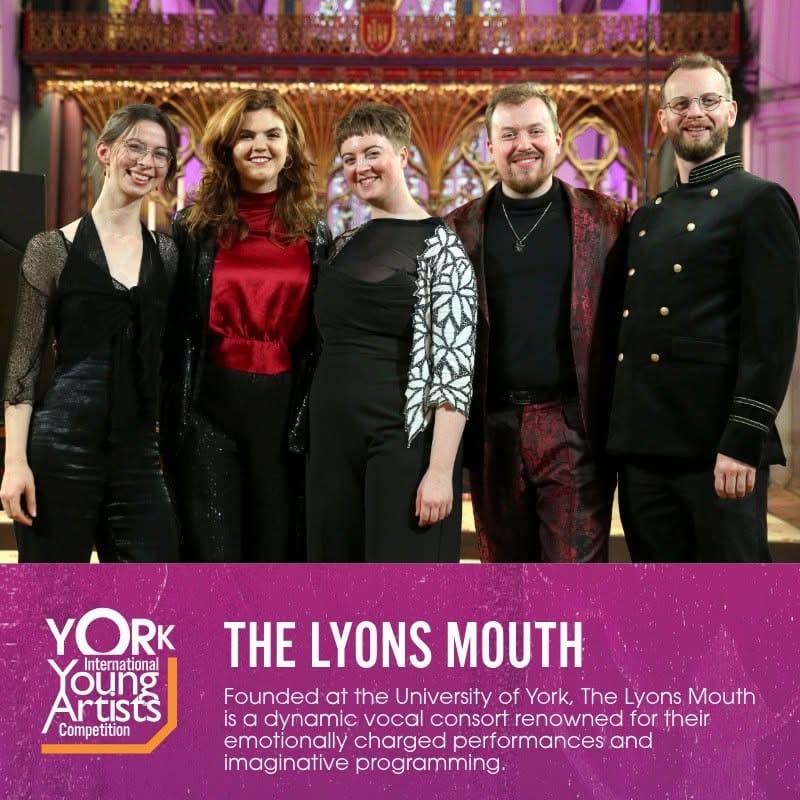
The Lyons Mouth’s profile for the International Young Artists Competition

The European Union Baroque Orchestra (EUBO) Development Trust Prize was shared between Ossian’s Dream and Tra Noi. The jury prize for the most promising young artist was awarded to Bianca Cucini.

The Cambridge Early Music Prize went to the trombone-based Lagrime. As noted above, La Mandorle was unlucky to lose out, but there can be no argument that the rest of the prizes were thoroughly well deserved.

Review by Martin Dreyer

HIGHLIGHTS of the competition will be broadcast on BBC Radio 3’s Early Music Show on August 30 at 5pm and will be available thereafter on BBC Sounds.

The Lyons Mouth win main prize at York International Young Artists Competition 2026. Who were the other award winners?

The Lyons Mouth

THE Lyons Mouth scooped two prizes in a home victory at the York International Young Artists Competition 2026 at the National Centre for Early Music on July 11.

The vocal ensemble of sopranos Ailsa Campbell and Elspeth Piggott, alto Ellie Stamp, tenors James Botcher and Jacob Ewens and bass Thomas Lowen, all University of York alumni, were awarded the main prize of a professional recording contract from Linn Records, a £1,000 cash prize, a future paid engagement with the York Early Music Festival and recording opportunities with BBC Radio 3.

In addition, The Lyons Mouth won the Friends of York Early Music Festival award, a cash prize of £500, while Tra Noi and Ossian’s Dream shared the cash prizes of £1,000, endowed by the EUBO Development Trust, for the Most Promising Young Artist/s specialising in the Baroque repertoire.

Lagrime won the Cambridge Music Prize, which includes a paid performance at Cambridge Early Music, and a new award, the Jury Prize, was awarded to gamba player Bianca Cucini, who performed with Tra Noi (bass viola da gamba, quinton) and I Mastricelli. (bass and  soprano viola da gamba).

The 2026 finalists were: I Mastricelli (Netherlands); Il Parrasio (Netherlands); Lagrime (Switzerland); La Mandorle (France); Nari Baroque Ensemble (Israel); Ossian’s Dream (Switzerland;) Quarterino (Switzerland); The Lyons Mouth (UK) and Tra Noi (Switzerland).

During the two days before the competition, each ensemble presented an informal recital at the NCEM, at St Margaret’s Church, Walmgate, with the aim of giving the musicians the opportunity to adapt to the performance space and to familiarise with the festival audience members in advance of the final.

These groups were selected from a pool of 56 ensembles from across the world and were judged by an international jury of Paul Agnew (Les Arts Florissants); Anna Danilevskaia (Sollazzo Ensemble); Kati Debretzeni (English Baroque Soloists), Veerle Declerk (Concertgebouw, Bruges) and Philip Hobbs (Linn Records).

The 2026 competition was presented by master of ceremonies Steven Devine, harpsichordist, fortepianist, conductor and director of orchestral, choral and opera repertoire and former York Early Music Festival artistic advisor.

Main prize winner The Lyons Mouth is a dynamic vocal consort founded in 2024 by singers who studied at the University of York. Inspired by their experiences performing in the Sir Jack Lyons Concert Hall, they created an ensemble devoted to vivid musical storytelling, crafting emotionally immersive performances that draw audiences into the dramatic heart of the repertoire.

In the final, the consort performed Victoria’s Secret: Claudio Monteverdi’s Svogava con le stele; Raffaella Aleotti’s Vidi speciosam; Monteverdi’s Sì, ch’io vorrei morire, Sigismondo d’India’s Dispietata pietate and Tomás Luis de Victoria’s Vadam et circuibo civitatem.

At the end of the competition, judging panel chair Philip Hobbs, from Linn Records, said: “I am always amazed and astonished at how this competition re-imagines and re-invents itself year after year, ensuring that early music has an exciting future and will continue to captivate audiences all over the world.

“Linn Records is very proud to continue this important relationship with the York Early Music Festival and I would like to congratulate the nine ensembles who took part in this fabulous day of music.”

Steven Devine said: “There were two things that, for me, really stood out about this year’s competition.  The sheer range of music was the first thing: almost 200 years of music was being performed by historically informed performers but with a sense of musicianship and virtuosity that was jaw-dropping. 

“They wore their scholarship lightly and at the service of their raw talent.  In addition, the supportive atmosphere between the groups and their enjoyment of each other’s work was wonderful to watch.  Definitely one of the highpoints of my musical experiences.”

Festival director and NCEM director Dr Delma Tomlin said: “The competition provided an amazing finale to our 50th edition, proving that early music can truly transport us Beyond Borders. The musicianship today was of the highest calibre and our nine ensembles gave us a range of exquisite music, spanning 400 years. As always, it was a pleasure to welcome the young artists to York and help them on their journeys to future success.

“I would also like to say a huge thank-you to our panel of judges for their hard work and support, to Steven Devine for his expertise and invaluable help and, of course, to our friends and supporters BBC Radio 3.”

The Lyons Mouth said: “We’re absolutely thrilled to have received not one but two prizes in this year’s competition. To have done it in our home city of York makes this moment feel even more special!

“It was a real treat to meet so many fantastic musicians in the competition, and inspiring to watch them perform. We’d love to say a huge thank-you to the Friends for choosing us for their award: as an ensemble who values the audience’s experience above all, this was really meaningful for us.

“We’re excited to record with Linn Records and to return to the festival next year. This whole experience feels like an amazing next step and we can’t wait to see where it takes us.”

 The competition provided a spectacular finale to the nine-day festival, where old friends and new connected through concerts, recitals and workshops staged in historic venues around the city.

The recitals from this year’s final are available to watch on demand on the NCEM’s ncem.co.uk website and YouTube channel and edited highlights will be shared on BBC Radio 3’s Early Music Show on Sunday, August 30 at 5pm.

The nine ensembles taking part were:

I Mastricelli: An early music ensemble founded in 2023 at the Royal Conservatoire in The Hague. Its name evokes the “mastricelli”, talented young musicians who assisted the great maestri of the Neapolitan conservatories. Featuring cello, viola da gamba and other bass instruments of the violin and viol families, I Mastricelli explores the expressive depth and resonance of the bass register, the foundation of Baroque sound.

Il Parrasio: The name Il Parrasio is derived from “Il Bosco Parrasio”, the hilly grove of trees overlooking the city of Rome where, every summer, the great and varied artistic minds of the Arcadian Poets met to discuss strategies for influencing all facets of Italian art culture away from the overindulgence of the high baroque and towards a return to more simple and natural styles.The ensemble focuses on the vibrant and expressive styles of the Venetian repertoire.

La Mandorle: La Mandorle (meaning almond in Italian) is a family affair, seeking to bring baroque music closer to the audience and to promote research into repertoire, with a particular taste for the French treasures of the 17th and 18th centuries. La Mandorle was awarded First Prize and Audience Prize at the International Haendel Competition in Göttingen in May 2025 and has been supported since 2024 by Sustainable-Eeemerging.

Lagrime: Led by trombonist Maximilien Brisson, Lagrime was formed after the release of the album Scorrete lagrime mie to continue to showcase the vocality of the baroque trombone. From its inclusion in church music-making circa 1500, the trombone has been associated with the voice perhaps more than any other instrument, and Lagrime explores the vocal virtuosity of the baroque trombone in intimate settings.

Nari Baroque Ensemble: Since 2019, the Nari Baroque Ensemble has specialised in performing baroque music on period instruments. Selected as Fabulous Fringe at the Utrecht Early Music Festival 2025 and winners of the main prize at the Göttingen Händel Competition 2024, each of Nari’s performances tells a story by combining original texts with excerpts from cantatas and sonatas.

Ossian’s Dream: This collective of musicians focuses on performing mainly chamber music from the 18th and 19th centuries under historically informed conditions. They are committed to rediscovering and re-enacting salon practices, understanding the salon as a place of artistic freedom, interdisciplinarity and gender issues.

Inspired by the famous painting by Dominique Ingres, the name refers to one of the most fascinating phenomena of the Romantic era, the revival of the mythical figure of Ossian.

Quarterino: These four musicians, who met through the European Union Baroque Orchestra, are preparing various projects in Switzerland, Italy and the Netherlands. Each member ensemble has taken part in ensembles and festivals throughout Europe, including York, Bremen, Utrecht and Urbino. They are also principal continuo players in EUBO 2025.

The Lyons Mouth: Dynamic vocal consort of young professional singers who first met while studying at the University of York under the guidance of Robert Hollingworth, director of the vocal group I Fagiolini.

Their early experiences performing in the Sir Jack Lyons Concert Hall inspired them to create an ensemble that would bring audiences into the dramatic and emotional heart of vocal music. Its members already sing with the BBC Singers; I Fagiolini; The Swingles; Voces8; Tenebrae; Dunedin Consort and The Norwegian Soloistchoir.

Tra Noi: Tra Noi is characterised by lively communication, both with each other and with theaudience. The ensemble was formed in 2023 and already has won the 2023 ‘Wiener Konzerthauspreis’ of the H.I.F.-Biber Competition; the 2023 Biagio Marini Competition Audience Prize; the 2024 Göttingen Handel Competition; first prize at the 2024 Concours International de musique ancienne du Val de Loire; third prize at the 2024 International Van Wassenaer Competition, as a duo formation, and first prize, audience prize and Gamba Gesellschaft Prize at the 2025  Orlando Lasso competition in Landshut, Germany.