

The Lyons Mouth: Winners of the Main Prize and Friends of York Early Music Festival Prize at York Early Music Festival’s International Young Artists Competition. Picture: Charlie Kirkpatrick
THIS biennial competition, for ensembles of at least three members with an average age no more than 35, attracted 56 entries this year. Nine of these reached the final, three each from the Netherlands and Switzerland and one each from France, Israel and the United Kingdom.
Two featured a solo soprano and one consisted of six unaccompanied singers. The remaining six were purely instrumental. There were three trios, four quartets and two sextets.
So much for statistics. However, they suggest, quite accurately, that there was variety aplenty. Technical standards were extremely high, reflecting the professionalism of early music teaching across European conservatories these days. ’Twas not always so.

Ossian’s Dream: Joint winners of European Union Baroque Orchestra (EUBO) Development Trust Prize. Picture: Shelagh Bourke
Eleven criteria were listed as assessable by the international jury. Only one, however, touched on that indefinable X-factor that marks out a performer as destined for a serious career: presentation. It involves the kind of charisma that conveys a good deal more than merely the music itself and is intertwined with a performer’s personality. Inevitably this was much rarer here.
Each group was allotted 20 minutes to display its wares. The sextet Ossian’s Dream was distinctive in sticking largely to the 19th century, with the historical clarinet of Claudia Reyes Segovia at its centre. After a crisp, not to say dramatic, account of Mendelssohn’s First Walpurgisnacht overture, there was strong contrast in the slow movement of Weber’s Clarinet Quintet, whose jovial centre was much enhanced by the clarinet. The finale of Mendelssohn’s C minor Piano Trio was truly effervescent.
The stand-out player of the quartet I Mastricelli was Bianca Cucini, whose soprano gamba dominated their set. With her colleagues confined to bass gamba, cello and organ, colours were otherwise regularly dark. A Tobias Hume almain and a lively, cross-accented Recercada by Diego Ortíz were but warm-up acts for the increasingly vivid variations in the Diferencias on ‘La dama le demanda’, by Antonio de Cabezón, which featured riffs from all four players.
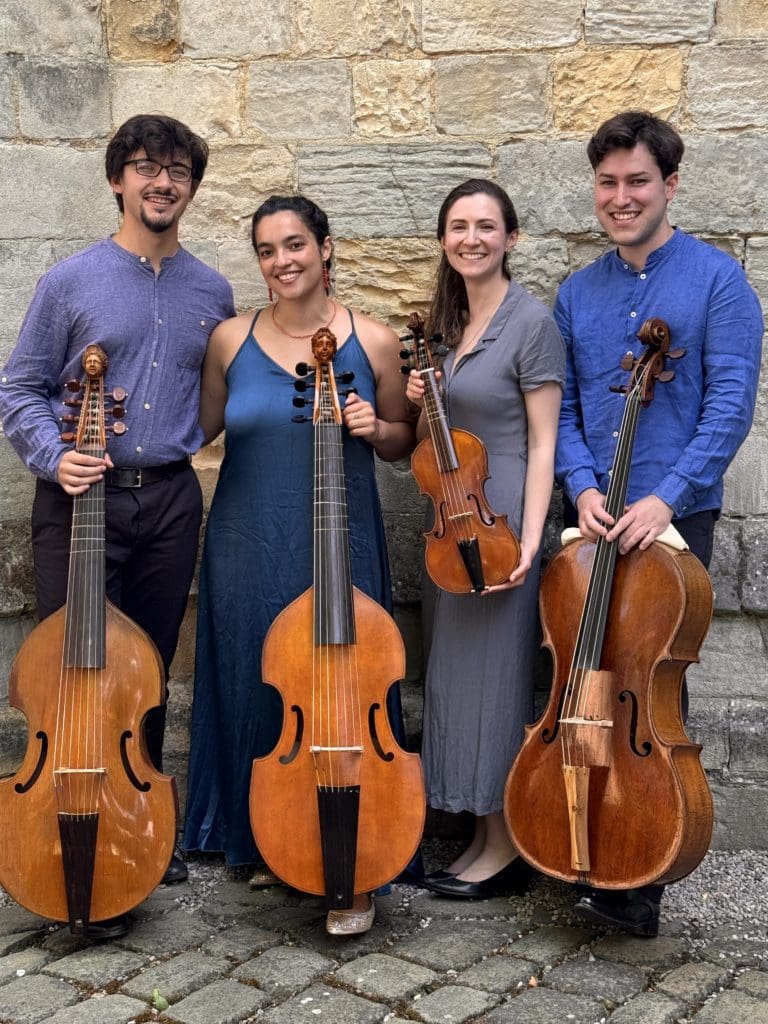
I Mastricelli, featuring jury prize for the most promising young artist winner Bianca Cucini. Picture: Charlie Kirkpatrick
Recorder, harpsichord and cello provided the underlay for soprano Liron Givona in the Nari Baroque Ensemble. She was fuller voiced than one might have expected in this repertory, but her tone was flexible even when slightly diffuse.
She trilled neatly alongside a sopranino recorder nightingale. The cellist was underpowered more than once here, but delivered some very rapid obbligato in a forceful little melodrama from a Pepusch cantata, ‘When Love’s Soft Passion’.
The French quartet La Mandorle – oboe, violin, cello and theorbo – focused on native composers from the generation just before Bach, all played without scores. Victoire Delnatte’s oboe was engagingly clean and full-bodied and Elodie Brzustowsk’s theorbo proved fluent.

Lagrime: Winners of the Cambridge Early Music Prize. Picture: Charlie Kirkpatrick
The ensemble was rhythmically alive in Clérambault’s La Félicité suite and equally idiomatic in a Robert de Visée suite, in whose Gigue the oboist briefly slapped rhythm on the cello. This group was unlucky not to be among the prizewinners. We shall certainly hear from them again.
Bianca Cucini reappeared in the Swiss trio Tra Noi, playing bass gamba and quinton (a descant viol) alongside recorder and harpsichord. A rather pallid Passacaglia by Andrea Falconieri nearly let them down, but ensemble remained taut in the same composer’s Ciaccona at a rapid tempo.
However it was Nicola Matteis’ Diverse Bizzarrie that showed how technically dazzling a chaconne can be in the right hands. Spearheaded by Silvia Berchtold’s recorder, Tra Noi took all its hurdles in their stride.

Tra Noi: Joint winner of the European Union Baroque Orchestra (EUBO) Development Trust Prize. Picture: Charlie Kirkpatrick
Handel and his Italian rivals, Porpora and Geminiani, all born within two years of each other, were the targets of Dutch quartet Il Parrasio, with a standard line-up of two violins, cello and harpsichord or organ. It was all very stylish but lacking in daring.
There was clarity and balance in a Sinfonia da Camera by Porpora, and a delicately phrased Allegro in Handel’s Op 5 No 1 trio sonata. Geminiani’s Andante affettuoso (The Enchanted Forest) lacked emotion. It was a case of nearly there, but not quite.
Another Dutch quartet, Quarterino, with Tomasso Simonetta Sandri’s flute replacing one of the violins, took a similar tack, this time with Charles Avison heard between Geminiani and Vivaldi. Avison’s two allegros in a G minor trio sonata were impressive, one a snappy fugue, the other with tight-knit accents. But Vivaldi’s trio sonata, RV84 in D, fell down on two counts, a garbled opening Allegro, taken too fast, and an oddly chromatic ending that failed to convince.

Bianca Cucini: Winner of the jury prize for the most promising young artist, who played with both I Mastricelli and Tra Noi at the International Young Artists Competition. Picture: Charlie Kirkpatrick
The Swiss trio Lagrime boasted the unusual line-up of soprano, Baroque trombone and theorbo, neither of the latter two using scores. All five of their pieces were settings of texts from the Song of Songs and some introduced a modicum of stage movement.
Franziska Blömer’s straight-toned soprano was ideally suited to music of the early Baroque, and Maximilien Brisson’s quietly velvety trombone was superbly controlled. The two duetted beautifully, conversing in Claudia Rusca’s Ego dormio and harnessed movingly in Vulnerasti cor meum by Giovanni Sances.
Finally, we had the British vocal sextet The Lyons Mouth, three female voices, three male, whose name derives from their shared background at the University of York. They appeared barefooted, without scores.

Bianca Cucini receiving her prize from Philip Hobbs. Picture: Charlie Kirkpatrick
Alongside two madrigals from Monteverdi’s Fourth Book, they offered three motets, one of them by the nun Raffaella Aleotti, thought to have been the earliest woman to have sacred music published. The group was remarkable for its ability to maintain a tight blend despite relatively full- throated delivery.
There was nothing precious about Monteverdi’s chromatic Sì, ch’io vorrie morire, nor were they afraid of the scrunchy discords in Sigismondo d’India’s Dispietata pietate. But there was more variation, even tenderness, in Victoria’s Vadam et circuibo civitatem from the Song of Songs.
Perhaps with the advantage of performing last and certainly through their assured ensemble, The Lyons Mouth carried off the overall First Prize, as well as the Friends of York Early Music Festival Prize.
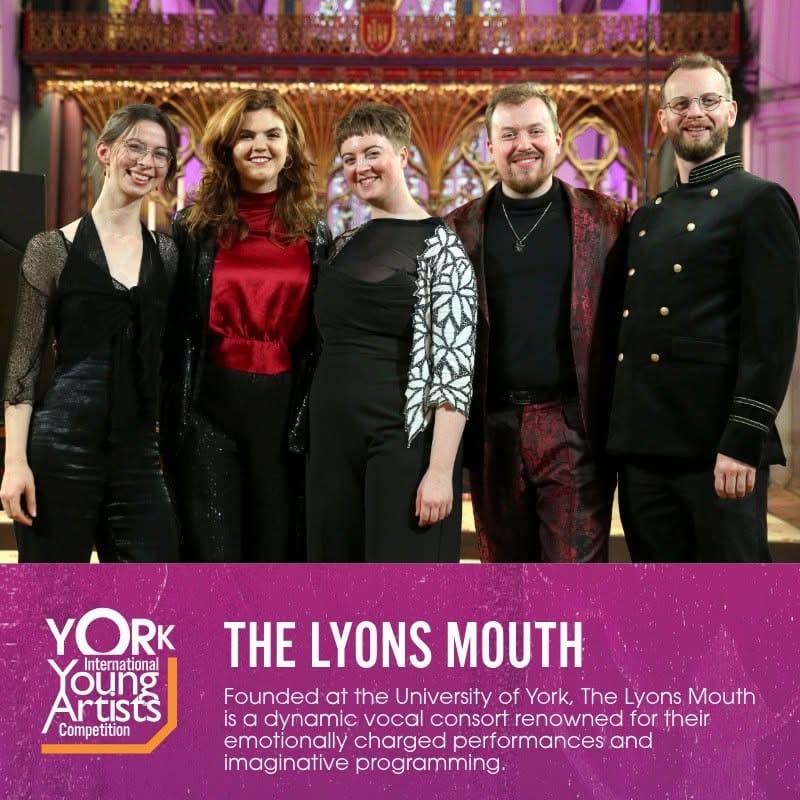
The Lyons Mouth’s profile for the International Young Artists Competition
The European Union Baroque Orchestra (EUBO) Development Trust Prize was shared between Ossian’s Dream and Tra Noi. The jury prize for the most promising young artist was awarded to Bianca Cucini.
The Cambridge Early Music Prize went to the trombone-based Lagrime. As noted above, La Mandorle was unlucky to lose out, but there can be no argument that the rest of the prizes were thoroughly well deserved.
Review by Martin Dreyer
HIGHLIGHTS of the competition will be broadcast on BBC Radio 3’s Early Music Show on August 30 at 5pm and will be available thereafter on BBC Sounds.