The Lyons Mouth win main prize at York International Young Artists Competition 2026. Who were the other award winners?

The Lyons Mouth

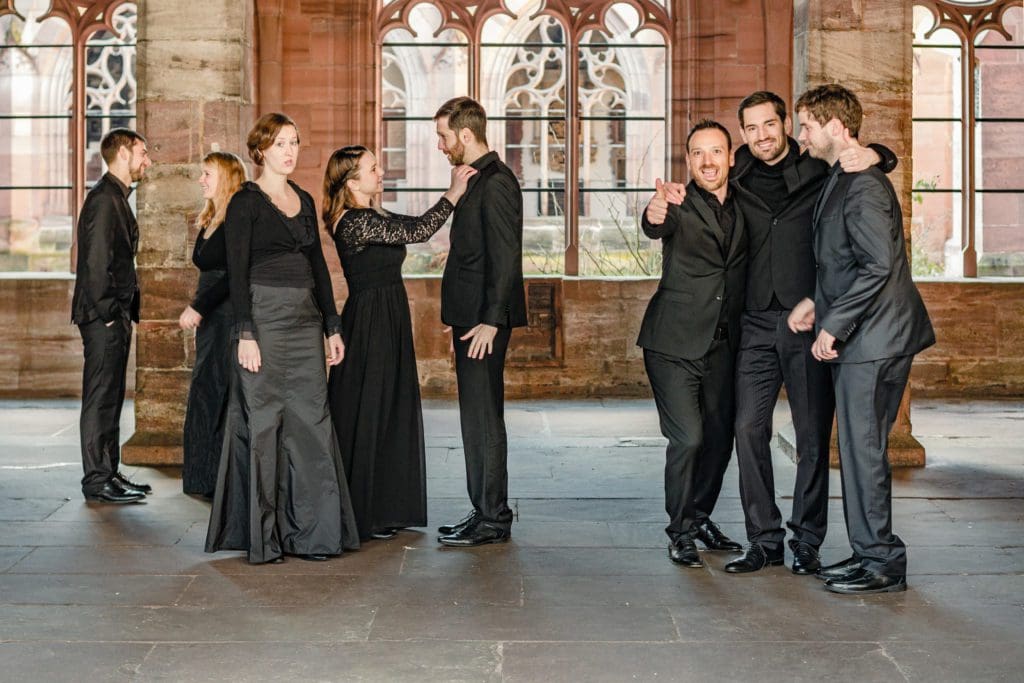
THE Lyons Mouth scooped two prizes in a home victory at the York International Young Artists Competition 2026 at the National Centre for Early Music on July 11.

The vocal ensemble of sopranos Ailsa Campbell and Elspeth Piggott, alto Ellie Stamp, tenors James Botcher and Jacob Ewens and bass Thomas Lowen, all University of York alumni, were awarded the main prize of a professional recording contract from Linn Records, a £1,000 cash prize, a future paid engagement with the York Early Music Festival and recording opportunities with BBC Radio 3.

In addition, The Lyons Mouth won the Friends of York Early Music Festival award, a cash prize of £500, while Tra Noi and Ossian’s Dream shared the cash prizes of £1,000, endowed by the EUBO Development Trust, for the Most Promising Young Artist/s specialising in the Baroque repertoire.

Lagrime won the Cambridge Music Prize, which includes a paid performance at Cambridge Early Music, and a new award, the Jury Prize, was awarded to gamba player Bianca Cucini, who performed with Tra Noi (bass viola da gamba, quinton) and I Mastricelli. (bass and  soprano viola da gamba).

The 2026 finalists were: I Mastricelli (Netherlands); Il Parrasio (Netherlands); Lagrime (Switzerland); La Mandorle (France); Nari Baroque Ensemble (Israel); Ossian’s Dream (Switzerland;) Quarterino (Switzerland); The Lyons Mouth (UK) and Tra Noi (Switzerland).

During the two days before the competition, each ensemble presented an informal recital at the NCEM, at St Margaret’s Church, Walmgate, with the aim of giving the musicians the opportunity to adapt to the performance space and to familiarise with the festival audience members in advance of the final.

These groups were selected from a pool of 56 ensembles from across the world and were judged by an international jury of Paul Agnew (Les Arts Florissants); Anna Danilevskaia (Sollazzo Ensemble); Kati Debretzeni (English Baroque Soloists), Veerle Declerk (Concertgebouw, Bruges) and Philip Hobbs (Linn Records).

The 2026 competition was presented by master of ceremonies Steven Devine, harpsichordist, fortepianist, conductor and director of orchestral, choral and opera repertoire and former York Early Music Festival artistic advisor.

Main prize winner The Lyons Mouth is a dynamic vocal consort founded in 2024 by singers who studied at the University of York. Inspired by their experiences performing in the Sir Jack Lyons Concert Hall, they created an ensemble devoted to vivid musical storytelling, crafting emotionally immersive performances that draw audiences into the dramatic heart of the repertoire.

In the final, the consort performed Victoria’s Secret: Claudio Monteverdi’s Svogava con le stele; Raffaella Aleotti’s Vidi speciosam; Monteverdi’s Sì, ch’io vorrei morire, Sigismondo d’India’s Dispietata pietate and Tomás Luis de Victoria’s Vadam et circuibo civitatem.

At the end of the competition, judging panel chair Philip Hobbs, from Linn Records, said: “I am always amazed and astonished at how this competition re-imagines and re-invents itself year after year, ensuring that early music has an exciting future and will continue to captivate audiences all over the world.

“Linn Records is very proud to continue this important relationship with the York Early Music Festival and I would like to congratulate the nine ensembles who took part in this fabulous day of music.”

Steven Devine said: “There were two things that, for me, really stood out about this year’s competition.  The sheer range of music was the first thing: almost 200 years of music was being performed by historically informed performers but with a sense of musicianship and virtuosity that was jaw-dropping. 

“They wore their scholarship lightly and at the service of their raw talent.  In addition, the supportive atmosphere between the groups and their enjoyment of each other’s work was wonderful to watch.  Definitely one of the highpoints of my musical experiences.”

Festival director and NCEM director Dr Delma Tomlin said: “The competition provided an amazing finale to our 50th edition, proving that early music can truly transport us Beyond Borders. The musicianship today was of the highest calibre and our nine ensembles gave us a range of exquisite music, spanning 400 years. As always, it was a pleasure to welcome the young artists to York and help them on their journeys to future success.

“I would also like to say a huge thank-you to our panel of judges for their hard work and support, to Steven Devine for his expertise and invaluable help and, of course, to our friends and supporters BBC Radio 3.”

The Lyons Mouth said: “We’re absolutely thrilled to have received not one but two prizes in this year’s competition. To have done it in our home city of York makes this moment feel even more special!

“It was a real treat to meet so many fantastic musicians in the competition, and inspiring to watch them perform. We’d love to say a huge thank-you to the Friends for choosing us for their award: as an ensemble who values the audience’s experience above all, this was really meaningful for us.

“We’re excited to record with Linn Records and to return to the festival next year. This whole experience feels like an amazing next step and we can’t wait to see where it takes us.”

 The competition provided a spectacular finale to the nine-day festival, where old friends and new connected through concerts, recitals and workshops staged in historic venues around the city.

The recitals from this year’s final are available to watch on demand on the NCEM’s ncem.co.uk website and YouTube channel and edited highlights will be shared on BBC Radio 3’s Early Music Show on Sunday, August 30 at 5pm.

The nine ensembles taking part were:

I Mastricelli: An early music ensemble founded in 2023 at the Royal Conservatoire in The Hague. Its name evokes the “mastricelli”, talented young musicians who assisted the great maestri of the Neapolitan conservatories. Featuring cello, viola da gamba and other bass instruments of the violin and viol families, I Mastricelli explores the expressive depth and resonance of the bass register, the foundation of Baroque sound.

Il Parrasio: The name Il Parrasio is derived from “Il Bosco Parrasio”, the hilly grove of trees overlooking the city of Rome where, every summer, the great and varied artistic minds of the Arcadian Poets met to discuss strategies for influencing all facets of Italian art culture away from the overindulgence of the high baroque and towards a return to more simple and natural styles.The ensemble focuses on the vibrant and expressive styles of the Venetian repertoire.

La Mandorle: La Mandorle (meaning almond in Italian) is a family affair, seeking to bring baroque music closer to the audience and to promote research into repertoire, with a particular taste for the French treasures of the 17th and 18th centuries. La Mandorle was awarded First Prize and Audience Prize at the International Haendel Competition in Göttingen in May 2025 and has been supported since 2024 by Sustainable-Eeemerging.

Lagrime: Led by trombonist Maximilien Brisson, Lagrime was formed after the release of the album Scorrete lagrime mie to continue to showcase the vocality of the baroque trombone. From its inclusion in church music-making circa 1500, the trombone has been associated with the voice perhaps more than any other instrument, and Lagrime explores the vocal virtuosity of the baroque trombone in intimate settings.

Nari Baroque Ensemble: Since 2019, the Nari Baroque Ensemble has specialised in performing baroque music on period instruments. Selected as Fabulous Fringe at the Utrecht Early Music Festival 2025 and winners of the main prize at the Göttingen Händel Competition 2024, each of Nari’s performances tells a story by combining original texts with excerpts from cantatas and sonatas.

Ossian’s Dream: This collective of musicians focuses on performing mainly chamber music from the 18th and 19th centuries under historically informed conditions. They are committed to rediscovering and re-enacting salon practices, understanding the salon as a place of artistic freedom, interdisciplinarity and gender issues.

Inspired by the famous painting by Dominique Ingres, the name refers to one of the most fascinating phenomena of the Romantic era, the revival of the mythical figure of Ossian.

Quarterino: These four musicians, who met through the European Union Baroque Orchestra, are preparing various projects in Switzerland, Italy and the Netherlands. Each member ensemble has taken part in ensembles and festivals throughout Europe, including York, Bremen, Utrecht and Urbino. They are also principal continuo players in EUBO 2025.

The Lyons Mouth: Dynamic vocal consort of young professional singers who first met while studying at the University of York under the guidance of Robert Hollingworth, director of the vocal group I Fagiolini.

Their early experiences performing in the Sir Jack Lyons Concert Hall inspired them to create an ensemble that would bring audiences into the dramatic and emotional heart of vocal music. Its members already sing with the BBC Singers; I Fagiolini; The Swingles; Voces8; Tenebrae; Dunedin Consort and The Norwegian Soloistchoir.

Tra Noi: Tra Noi is characterised by lively communication, both with each other and with theaudience. The ensemble was formed in 2023 and already has won the 2023 ‘Wiener Konzerthauspreis’ of the H.I.F.-Biber Competition; the 2023 Biagio Marini Competition Audience Prize; the 2024 Göttingen Handel Competition; first prize at the 2024 Concours International de musique ancienne du Val de Loire; third prize at the 2024 International Van Wassenaer Competition, as a duo formation, and first prize, audience prize and Gamba Gesellschaft Prize at the 2025  Orlando Lasso competition in Landshut, Germany.

NCEM welcomes global applications for York International Young Artists Competition. Entry deadline: January 15

Protean Quartet: Winners of the 2022 York International Young Artists Competition, pictured at the NCEM

APPLICATIONS from ensembles across the world are invited for next year’s York International Young Artists Competition. The closing date is January 15 2024.

This longstanding competition for young ensembles will take place from July 10 to 13 at the National Centre for Early Music, Walmgate, York, as part of York Early Music Festival 2024.

The final will take place on Saturday, July 13 with a day of public performances at the NCEM. The first prize includes a recording contract from Linn Records; a £1,000 prize; opportunities to work with BBC Radio 3 and a concert at the 2025 York Early Music Festival.

Further prizes on offer include: the Friends of York Early Music Festival Prize, the Cambridge Early Music Prize and one for The Most Promising Young Artist/s, endorsed by the EUBO Development Trust. 

The competition is open to early music ensembles with a minimum of three members and an average age of 32 years or under and a maximum age of 36 for individuals.

The ensembles must demonstrate historically informed performance practice and play repertory spanning the Middle Ages to the 19th century on period instruments.

The competition is recognised as a major international platform for emerging talent in the world of early music. Attracting musicians from all over the globe, it offers a major boost to young professional careers with opportunities for performance, recording and broadcasting, plus international exposure. 

Festival director and NCEM founder Delma Tomlin says: “We’re delighted to be staging the Young Artists competition once again in 2024. One of the highlights of our festival, the competition takes place every two years and fills every corner of the NCEM with music and laughter. 

“We believe it is extremely important to nurture and develop young talent, and the competition provides an important opportunity for young artists and musicians not just from the UK but from all over the world.” 

Last year’s winners, Protean Quartet, say: “We were delighted and honoured to win the main prize in 2022. Taking part in the competition was an amazing experience. It was wonderful performing at the NCEM’s home, the beautiful St Margaret’s Church, and meeting the other ensemble who were taking part. The prize provides a real boost to our confidence, profile and careers.”

Protean Quartet performed at last summer’s festival, as did 2019 winners L’Apothéose, who say: “Winning the York competition was an extremely important and prestigious recognition of our career. It was wonderful to return to York for the recording of our CD with Linn Records and to appear at the York Early Music Festival last July.”

For details of how to apply, head to: www.yorkcomp.ncem.co.uk or email yorkcomp@ncem.co.uk

York Early Music Festival rejoices in return to full-strength programme from July 8

Director Harry Christophers (holding rail, sixth from left) with seemingly rather more than 16 in The Sixteen, playing York Early Music Festival on July 9

FOR the first time since 2019, the York Early Music Festival will be at full strength this summer for nine days of concerts, talks and workshops under the theme of Connections.

Highlights during the festival run from July 8 to 16 include The Sixteen, The Tallis Scholars and Gabrieli Consort & Players, all at York Minster, and the return of the York International Young Artists Competition.

The programme also features gamba specialists Paolo Pandolfo & Amélie Chemin; The Gonzaga Band; The Rose Consort of Viols; the University of York Baroque Ensemble; Orí Harmelin; Profeti della Quinta; the Yorkshire Baroque Soloists and Ensemble Voces Suaves.

Tickets are on sale on 01904 658338, at ncem.co.uk or via email to boxoffice@ncem.co.uk, with discounts available for Friends and under 35s.

“The festival presents a series of concerts linked together through a maze of interconnecting composers, shining a light on the many connections that hold us together in the past and into the future,” says director Delma Tomlin, explaining the festival theme.

“This year’s theme is Connections, connecting and indeed reconnecting music, artists and, of course, our audiences,” says York Early Music Festival director Delma Tomlin

Concerts will be supported by a series of illustrated talks, workshops, opportunities to ‘Come and Sing’ and informal recitals at a festival presented in historical venues such as York Minster, the Merchant Adventurers’ Hall, St Lawrence’s Church and the festival headquarters, the National Centre for Early Music (NCEM), in the medieval St Margaret’s Church building in Walmgate.

The festival’s grand finale will be the York International Young Artists Competition 2022, wherein ten groups from across Europe will give informal recitals at the NCEM at 10am and 2pm on July 14 and 15 before competing for the prize on July 16. 

The winners will receive a professional CD recording contract from Linn Records, a cheque for £1,000 and opportunities to work with BBC Radio 3 and the NCEM. Additional prizes will be supported by Cambridge Early Music, the European Union Baroque Orchestra Development Trust and the Friends of York Early Music Festival.

“We are delighted to be presenting a nine-day festival of music in our beautiful city, staged in some of the country’s most architecturally stunning buildings,” says Delma.

“This year’s theme is Connections, connecting and indeed reconnecting music, artists and, of course, our audiences. As always, we’ll be celebrating the glorious music of the past but also looking forward, as we’re able at last, to stage the York International Young Artists Competition, showcasing and nurturing the performers of the future.

The Tallis Scholars: Making Choral Connections at York Minster on July 11

“We’re so pleased to be back at full strength, and we can’t wait to welcome you to York for what promises to be one of the most exciting festivals to date.”

Those unable to attend are advised that the festival will be offering many of the concerts online across the summer. Full details will be available from ncem.co.uk.

Audience safety and comfort is a continuing priority in an ever-changing environment for the NCEM and York Early Music Festival. Check out the full guidance at ncem.co.uk/covid-guidelines.

The 2022 York Early Music Festival programme:

July 8, 7.30pm: Paolo Pandolfo & Amélie Chemin, viola da gamba duo, Heavans Joy, The World of the Virtuoso Viol, at NCEM, York.

July 9, 9.30am: Master And Pupil, workshop led by The Gonzaga Band director Jamie Savan, at Clements Hall, Nunthorpe Road, York. Singers and players of Renaissance wind and string instruments look at the polychoral repertory of Giovanni Gabrieli and Heinrich Schütz.

Ensemble Voces Suaves: Schutz happens at St Lawrence’s Church on July 15

July 9, 12 noon: The Sixteen Insight Day, at NCEM, York. Insight Day explores stories behind The Sixteen’s Choral Pilgrimage repertory. Discover more with singer and practical scholar Sally Dunkley, organist Robert Quinney and a consort of Sixteen singers.

July 9, 7.30pm: The Sixteen, Author Of Light, at York Minster. Harry Christophers directs a choral programme focused on Hubert Parry’s Songs Of Farewell.

July 10, 2pm: The Early Music Show, BBC Radio 3 live broadcast presented by Hannah French with selected festival guests, at NCEM; free to those attending a festival event. Immediately afterwards, violinist Kati Debretzeni presents delayed 2020 York Biennial Lifetime Achievement Award to violinist Catherine Mackintosh.

July 10, 4.45pm: Minster Minstrels, Fairest Isle, directed by Ailsa Batters, at Unitarian Chapel, St Saviourgate, York. NCEM’s youth instrumental ensemble performs music from the late 17th-century theatre, court and household to demonstrate the influence of the new Italian and French styles in post-Restoration England.

July 10, 7.30pm: The Gonzaga Band, Venice 1629, directed by cornett player Jamie Savan, at NCEM, York. Vocal works by Claudio Monteverdi and Alessandro Grandi and virtuosic Baroque instrumental music by wind player Dario Castello and violinist Biagio Marini feature in a series of snapshots from an extraordinary year in the life of this most musical of cities.

The Gonzaga Band: Snapshots of Venice, 1629 on July 10

July 11, 10.30am: Schutz In Venice, illustrated talk by Jamie Savan, at Bedern Hall, York. On his second visit to Venice in 1628-29, German composer Heinrich Schütz would surely have met Monteverdi, by now maestro di cappella at St Mark’s, but this talk also introduce lesser-known 1620s’ Venetian innovators in modern vocal and instrumental music.

July 11, 1pm: Rose Consort of Viols, with virginals player Steven Devine, Music For Severall Friends, at NCEM, York. Anniversary-marking concert of viol consort works by two British composers, the conservative Thomas Tomkins (born in 1572) and the more radical Matthew Locke (b.1622).

July 11, 7.30pm: The Tallis Scholars, Choral Connections, at York Minster. Director Peter Phillips explores connections between Josquin des Prez and his successor at the Sistine Chapel, Palestrina; Byrd and his English forebear Taverner.  

July 12, 10.30am: An Italian In London, illustrated talk on The Case of Angelo Notari, musician and spy, by Jonathan Wainwright, at Bedern Hall, York. Italian-born Notari moved to England in 1611, making his career as a court musician. Little was known about his time in Italy, until recently, prompting this examination of his  life and (newly attributed) compositions.

July 12, 1pm: La Vaghezza, Sculpting The Fabric, at St Lawrence’s Church, Hull Road, York.  Stars of the EEEmerging+ programme, this young Italian ensemble presents early-17th century Italian works by Cavalli, Merula, Vitali, Fontana and Rossi from debut album Sculpting The Fabric.

Gabrieli Consort & Players: Re-creating a Venetian Coronation at York Minster on July 13

July 12, 7.30pm: Profeti Della Quinta, Lamento d’Arianna, Italian Renaissance music from Rore to Monteverdi, at NCEM, York. Winners of the 2011 York Early Music International Young Artists Competition take a journey that connects early 16th-century ‘classical’ madrigal to Monteverdi’s ‘operatic’ solo madrigals in 17th-century Mantua. 

July 13, 1pm: University of York Baroque Ensemble, Mannheim Travels To Fife,
Early Symphonists and Two Brothers, at St Lawrence’s Church, Hull Road, York. Highlighting works by Mannheim symphony kick-starter Johann Stamitz, Italian brothers Giovanni Battista and Giuseppe Sammartini, Johann Christian Bach and Scottish composer Thomas Erskine.

July 13, 7.30pm: Gabrieli Consort & Players, A Venetian Coronation, 1595, directed by Paul McCreesh, at York Minster. Spectacular re-creation of the festive Coronation Mass of the Venetian Doge Marino Grimani at St Mark’s, Venice, in 1595, to mark the Gabrieli Consort’s 40th anniversary.

July 13, 9.45pm: Ori Harmelin, Neshima: The Hebrew For Breath, at Undercroft, Merchant Adventurers’ Hall, Fossgate, York. Theorbo specialist explores arrangements of madrigals, motets and chansons by Cipriano de Rore, Josquin des Prez and Thomas Tallis, complemented by Harmelin’s compositions and Irishman Simon McHale’s The Orbo.

July 14 and July 15, 10am and 2pm: International Young Artists Competition Recitals 1 and 2, at NCEM, York. Informal recitals featuring all the ensembles taking part in the 2022 competition, performing music from the Middle Ages to the early Classical period, introduced by master of ceremonies Professor John Bryan.

Ori Harmelin: Theorbo concert at Merchant Adventurers’ Hall on July 13

July 14, 7.30pm: Yorkshire Baroque Soloists, Bach’s Other Leipzig, directed by Peter Lawrence, at St Lawrence’s Church, Hull Road, York. Not only composing for two churches when in Leipzig, Bach also wrote four ‘Lutheran masses’ in 1738/39 and the Coffee Cantata for Zimmermann’s Caffeehaus, a miniature comic opera on the pressing subject of coffee addiction, featured here.

July 15, 4.30pm: Come and Sing Handel’s Messiah, at St Olave’s Church, Marygate, York. Peter Seymour, conductor, and Ben Horden, organ, invite allcomers to Come and Sing a selection of choruses from Handel’s Messiah in a short rehearsal and performance.

July 15, 7.30pm: Ensemble Voces Suaves, Enrico Sagittario: Heinrich Schütz in Italy, at St Lawrence’s Church, Hull Road, York. Exploration of the Italian side of German composer Heinrich Schutz, putting music from his debut collection alongside madrigals by Gabrieli and Monteverdi that inspired him, plus toccatas for theorbo by Girolamo Kapsberger, an Italian composer with roots in Germany.

July 16, 10am: York International Young Artists Competition, at NCEM, York. 2022 competition, featuring ten groups, will be presented by John Bryan and judged by Edward Blakeman, from BBC Radio 3; Albert Edelman, president of Réseau Européen de Musique Ancienne; Linn Records producer and recording engineer Philip Hobbs;  violinist Catherine Mackintosh and harpsichordist and professor Barbara Willi.

Profeti Della Quinta: Italian Renaissance music from Rore to Monteverdi at NCEM on July 12

Consone Quartet team up with NCEM and BBC Radio 3 for Young Composers Award

Consone Quartet: Partners in the NCEM Young Composers Award 2022

COMPOSERS aged 25 and under are invited to write a new work for string quartet for the NCEM Young Composers Award 2022.

Each year, the award is presented by the National Centre for Early Music, in York, in association with BBC Radio 3. For 2022, they are delighted to welcome the Consone Quartet, the BBC New Generation Artists, as creative partners, as announced on BBC Radio 3’s Early Music Show on November 21.

Composers are asked to write a new piece – three to four minutes in length – for string quartet, working alongside the Consone Quartet’s Agata Daraškaite, Magdalena Loth-Hill, Elitsa Bogdanova and George Ross, who play ‘period’ instruments using gut strings.

For next year’s award entries, they invite young composers to learn about the musical sound world of one of their favourite composers, Fanny Mendelssohn, a talented pianist who wrote 400 works but never enjoyed the acclaim that brother Felix received.  “This is the opportunity to create a new piece which explores this fascinating time in musical history,” they say.

Shortlisted composers will be invited to the Award Day at the NCEM, at St Margaret’s Church, Walmgate, when the shortlisted compositions will be presented by the Consone Quartet in a workshop led by composer Professor Christopher Fox.  In the evening, the Consone Quartet will perform each of the pieces for a panel of judges.

The two winning pieces, one from each age category (see below), will be premiered by the Consone Quartet at Stour Music Festival on June 26 2022, when the performance will be recorded for future broadcast on BBC Radio 3’s Early Music Show.

This major national annual award is open to young composers up to the age of 25, resident in the UK, and is divided into two categories: 18 and under and 19 to 25.

NCEM director Delma Tomlin says: “The Young Composers Award is one of the most important dates in the NCEM’s calendar and gives us a vital opportunity to work with the wider community. Last year, we received an astonishing number of applications from all over the UK and we’re sure that enthusiasm to take part will just keep on growing.

NCEM director Delma Tomlin: “Thrilled to be working with the Consone Quartet”

“For 2022, we’re thrilled to be working with the Consone Quartet, who will be guiding the shortlisted composers and performing their pieces. They’ll be joined in York by composer Professor Christopher Fox to host a day of workshops with the shortlisted candidates before the public performance in the evening. 

“This year, the compositions will be performed at the prestigious Stour Music Festival and, of course, broadcast on BBC Radio 3’s Early Music Show – a brilliant beginning for any young composer.”

Alan Davey, controller of BBC Radio 3 and classical music, says: “As Covid  restrictions lift and we are able to celebrate the return of live music to UK stages, BBC Radio 3 believes it is vital to give appreciation and encouragement to young composers and performers who represent the future of music in this country.

“That is why we are so proud to partner with the National Centre for Early Music’s 2022 Young Composer Award. Each year, it enables us to help audiences at home discover the brightest talents in Early Music practice, broadcasting their works on our Early Music Show.”

Consone Quartet are “thrilled to be joining forces” with the NCEM for the Young Composers Award. “Having competed in the NCEM’s International Young Artists Competition, we appreciate how much these sorts of opportunities can help to kickstart a young musician’s career,” they say. “We cannot wait to hear what the shortlisted composers have written, to work in more detail with them and eventually to perform their works.”

The Young Composers Award is an integral part of the NCEM’s work, with comments from the 2021 awards illustrating the impact and importance of the experience. Witness: “I have gained confidence in myself. Hearing my piece come to life was an incredible experience,” said one. “Great contacts and lots of fun!” said another. “Christopher Fox’s insightful comments, always thinking outside the box,” enthused a third.

The deadline for registration is 12 noon on Friday, February 18 2022; the deadline for submission of scores is 12 noon, Friday, March 18. Shortlisted candidates will be informed by April 8 and will be invited to attend the Award Day in York on May 19.

Terms and conditions and details of how to take part in the NCEM Young Composers Award 2022 are available at: youngcomposersaward.co.uk/2022 or by emailing info.composers@ncem.co.uk.

L’Apothéose in the grounds of the National Centre for Early Music, St Margaret’s Church, York, after winning the York International Young Artists Competition in 2019. Picture: Jim Poyner

YOUNG ENSEMBLES SOUGHT FOR YORK INTERNATIONAL YOUNG ARTISTS COMPETITION 2022

CALLING young ensembles of the world: the deadline for applications for next year’s York International Young Artists Competition is January 14 2022.

This prestigious longstanding competition for young ensembles will take place on Saturday, July 16 at the National Centre for Early Music as part of next summer’s York Early Music Festival. 

The first prize includes a recording contract from Linn Records: a £1,000 prize; opportunities to work with BBC Radio 3 and a concert at the 2023 York Early Music Festival.

Other prizes include: the Friends of York Early Music Festival Prize; the Cambridge Early Music Prize and a prize for The Most Promising Young Artist/s endowed by the EUBO Development Trust.  

The competition is open to Early Music ensembles with a minimum of three members; ensembles must have an average age of 33 years or under, with a maximum age of 37 years for individuals.

The ensembles must demonstrate historically informed performance practice and play repertory from any period, spanning the Middle Ages to the 19th century, on period instruments.

Sollazzo Ensemble: “Winning the competition was a turning point in our career”

The competition is recognised as a major international platform for emerging talent in the world of early music. Attracting musicians from all over the globe, it offers a boost to young professional careers with opportunities for performance, recording and broadcasting and international exposure. 

NCEM director Delma Tomlin says: “We are so pleased to be staging the 2022 competition, which brings together young musicians of the highest calibre from the UK and all over the world. 

“This is one of highlights of the York Early Music Festival and we are always overwhelmed by the superb quality of the performances from these fantastically talented young artists. The competition provides a joyous, optimistic finale to our festival and we are delighted to be able give these rising stars many exciting future opportunities.”

2019 winners L’Apothéose say: “Winning the York competition was an extremely important and prestigious recognition of our career, and taking part was an immensely joyful experience.” 

Fellow former winners Sollazzo Ensemble enthuse: “Winning the competition was a turning point in our career, bringing us to the attention of both a wider audience and professionals throughout Europe.”

Details of how to apply can be found at yorkcomp.ncem.co.uk; alternatively, send an email to yorkcomp@ncem.co.uk.

Next year’s York International Young Artists Competition postponed until July 2022

Winners: L’Apothéose in the grounds of the National Centre for Early Music after their success in the 2019 York International Young Artists Competition. Picture: Jim Poyner Photography

THE 2021 York International Young Artists Competition is to be postponed for a year.

In response to the Covid-19 pandemic, the prestigious classical music event will take place on July 13 to 16 2022 instead and subsequently will be staged every two years.

The competition is open to Early Music ensembles with a minimum of three members, who must have an average age of 32 years or under with a maximum age of 36. 

The ensembles must demonstrate historically informed performance practice and play repertory from any period, spanning the Middle Ages to the 19th century, on period instruments. 

This longstanding competition for young ensembles takes place at the National Centre for Early Music, St Margaret’s Church, Walmgate, as part of York Early Music Festival. 

​Recognised as an international platform for emerging talent in the world of Early Music, the competition attracts musicians across the globe, offering a boost to young professional careers with opportunities for performance, recording and broadcasting and international exposure.  

“Every year, we are overwhelmed by the superb quality of the performances from these fantastically talented young artists,” says NCEM director Delma Tomlin

The 2019 competition final included ten ensembles with artists from 14 different countries. Winners L’Apothéose, from Spain, received a professional recording contract from Linn Records, a £1,000 prize and chances to work with BBC Radio 3 and the NCEM.  

NCEM director Dr Delma Tomlin says:“The competition brings together young musicians of the highest calibre and is one of the highlights of the York Early Music Festival. With the competition attracting artists from all over the world, in the current climate we decided to move it to 2022.

“Every year, we are overwhelmed by the superb quality of the performances from these fantastically talented young artists and we hope that up-and-coming ensembles will take the opportunity to enter this world-renowned competition.” 

2019 winners L’Apothéose say: “Winning the York competition was an extremely important and prestigious recognition of our career, and taking part was an immensely joyful experience.” 

Fellow former winners Sollazzo Ensemble say: “Winning the competition was a turning point in our career, bringing us to the attention of both a wider audience and professionals throughout Europe.”

For details of how to apply, ensembles should go to ncem.co.uk or send an email to yorkcomp@ncem.co.uk.