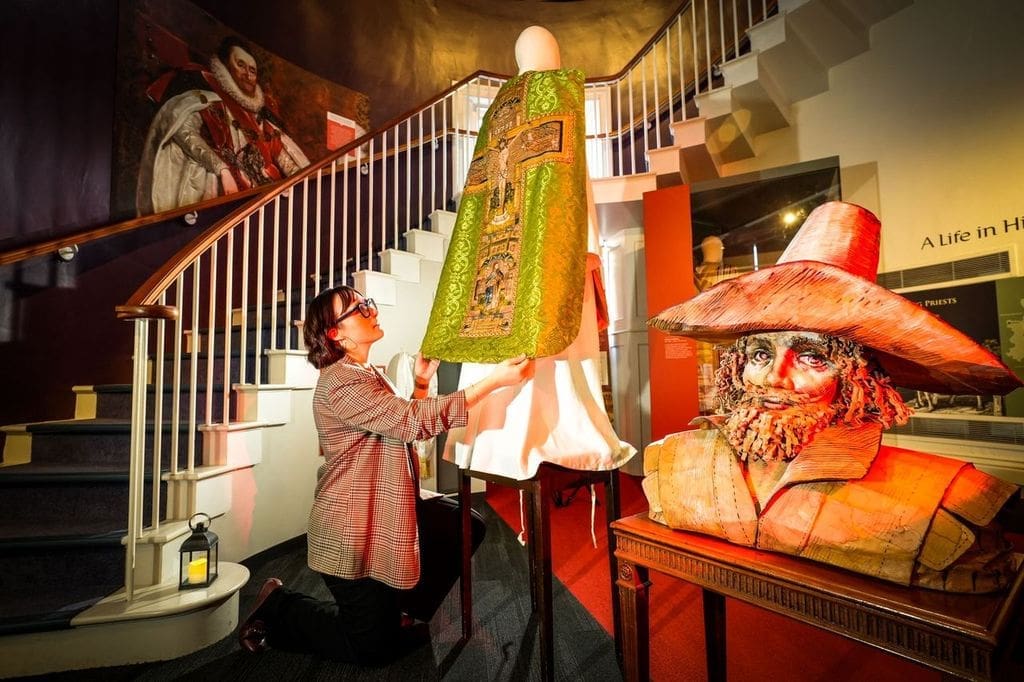
Bar Convent special collections manager Dr Hannah Thomas with the ‘Middleton Vestment’ at the centre of new Gunpowder Plot research. Alongside is York artist Sarah Hall Baqai’s sculpture A Man For All Treasons. Picture: Simon Dew
NEW research into the Gunpowder Plot has uncovered previously unexplored motives behind the involvement of Guy Fawkes and his fellow York conspirators. Find out more at The Gunpowder Plot: York’s Untold Story exhibition at the Bar Convent Living Heritage Centre in York.
The infamous failed plot to blow up the Houses of Parliament in 1605 sparked the Bonfire Night tradition that lights up skies across Great Britain on November 5 each year.
On show until December 5, the exhibition at the Bar Convent, in Blossom Street, is an exploration of the context, conspiracy and consequences surrounding that fateful day.
Gunpowder Plotters Guy Fawkes, Christopher and John Wright and Thomas Percy were all either from York or connected to the city. What was happening in York at that time? What led this group of young men to plan such an extreme act to overthrow King James I? What connects these men?
Research into the ‘Middleton Vestment’, a priest’s vestment donated to the convent by the Middleton family of Ilkley, has confirmed that it once belonged to the family of Margaret Clitherow, whose maiden name was Middleton.
Historians have theorised that Guy Fawkes and Christopher and John Wright may have witnessed, or certainly been aware of, Margaret Clitherow’s execution in York in 1586.
Accused of harbouring Catholic priests, but refusing to plead guilty to the charges, she was pressed to death at the Toolbooth on Ouse Bridge on March 25. Stripped to a linen shift, she was laid out with a sharp stone under her back, whereupon her own front door was placed over her and loaded with up to eight hundredweight of stones. The Bar Convent houses a sacred relic of her hand.
Further research has uncovered that the connection between Margaret Clitherow’s family and the Gunpowder Plotters was likely to be far closer than anyone realised.
Bar Convent special collections manager and research fellow Dr Hannah Thomas says: “Guy Fawkes, John and Christopher Wright were pupils at St Peter’s School in York. At the time of Margaret Clitherow’s death, Fawkes and Christopher Wright were 16, while John Wright was 18.
“Margaret Clitherow was accused of sheltering Catholic priests and was executed by pressing, which was exceptionally brutal, even by Elizabethan standards, and shocked the entire Catholic community.
“This alone would have had a profound effect on the plotters, but now imagine if they personally knew Margaret Clitherow. We believe this could very well be the case.”
“The ‘Middleton Vestment’ is likely to have belonged to Robert Middleton, and we now think it is quite likely that he was in fact Margaret Clitherow’s nephew. He was the same age as Guy Fawkes and living in York at the time. Additionally, both her stepson and son were close in age to Fawkes and the Wright brothers.”
Hannah continues: “Robert Middleton, along with Henry and William Clitherow, Margaret’s son and stepson, all joined the priesthood, and the details of their entrance records reveal that all three had received a high level of education as boys.

Special collections manager Dr Hannah Thomas Hannah Thomas holding the 15th century vestment that once belonged to a schoolfellow of the Gunpowder Plotters. In the foreground in the hidden chapel at Bar Convent is Sarah Hall Baqai’s sculpture A Man For All Seasons. Picture: Simon Dew
“At the time, the only place in York to receive an education of this standard was St Peter’s, a known Anglican School. Given that the school was small, with large numbers of children in mixed-age classrooms, these boys from local underground Catholic families would almost certainly have known each other and likely been friends due to the tight knit community their families were part of.
“Guy Fawkes’s contemporary, Robert Middleton, was executed for being a priest in 1601, just four years prior to the Gunpowder Plot, probably reinforcing Guy’s strong feelings against state-sanctioned persecution of Catholics, and perhaps encouraging him to start thinking about retaliation.
“Although very few official records survive from this period, through our extensive Catholic archives and knowledge of York Catholic networks through the post-reformation period, we have been able to fill these historical gaps.”
Dr Thomas has unfolded further fascinating connections and narratives too. On his journey to London from Edinburgh to claim the throne in 1603, King James I travelled through Yorkshire and even stayed with prominent Catholics, such as Sir William Ingleby at Ripley Castle, who was knighted in thanks for his hospitality.
Francis Ingleby, Sir William Ingleby’s uncle, was, in fact, the priest that Margaret Clitherow was hiding and he was executed following the raid on her house. Only months later, despite promises of religious tolerance, King James brought in new and even stricter laws against Catholics.
Interestingly, Sir William Ingleby is also the first cousin of plotters Robert and Thomas Winter, and, additionally, is a second cousin of Thomas Gascoigne, who lent the money to Sr Frances Bedingfield to purchase the house that became the Bar Convent. Conclusion: all these stories are connected in an intricate web.
The Gunpowder Plot: York’s Untold Story, Bar Convent Living Heritage Centre, York, until December 5, open Monday to Saturday, 10am to 5pm; last admission to exhibition at 4pm. Bookings: barconvent.co.uk.
Special events at Bar Convent
The Gunpowder Plot: After Hours, November 3, 6pm, presented in partnership with York Dungeon
THIS is an evening to remember, remember as you uncover the real history behind Bonfire Night. Experience the Bar Convent after-hours, where you will gather by candlelight in the hidden chapel and come face-to-face with York’s most infamous son. Discover the man behind the barrels as Guy Fawkes awaits his fate in the final hour before his execution.
The evening continues in the exhibition with a retelling of one of the most dramatic events in British history. Set against the turbulent backdrop of post-Reformation York, explore the context, conspiracy and consequences of the event surrounding November 5 1605.
Through rare objects, new interpretation and storytelling, the exhibition reveals how the plot echoed across the country, left its mark on York, and shaped the lives of the courageous women who founded this house in its wake.
To book, go to barconvent.co.uk;alcoholic or soft drink included.
Lunchtime talk: The Gunpowder Crucifix, November 5, 1pm
DELVE deeper into the story behind Edward Oldcorne’s crucifix, the only surviving sacred object of the raids on Catholic properties after The Gunpowder Plot. Discover how and why its owner was hanged, drawn and quartered despite his innocence, how it came to be in the convent’s collections and more. Included in admission to the exhibition (barconvent.co.uk); allow 20 to 30 minutes.
The Gunpowder Plot Walking Trail
WALK in the footsteps of the Gunpowder Plotters on this fascinating self-guided trail through the historic streets of York. Visit key locations and iconic landmarks that give context to one of the most dramatic events in British history. Self-guided, free; more information at barconvent.co.uk.