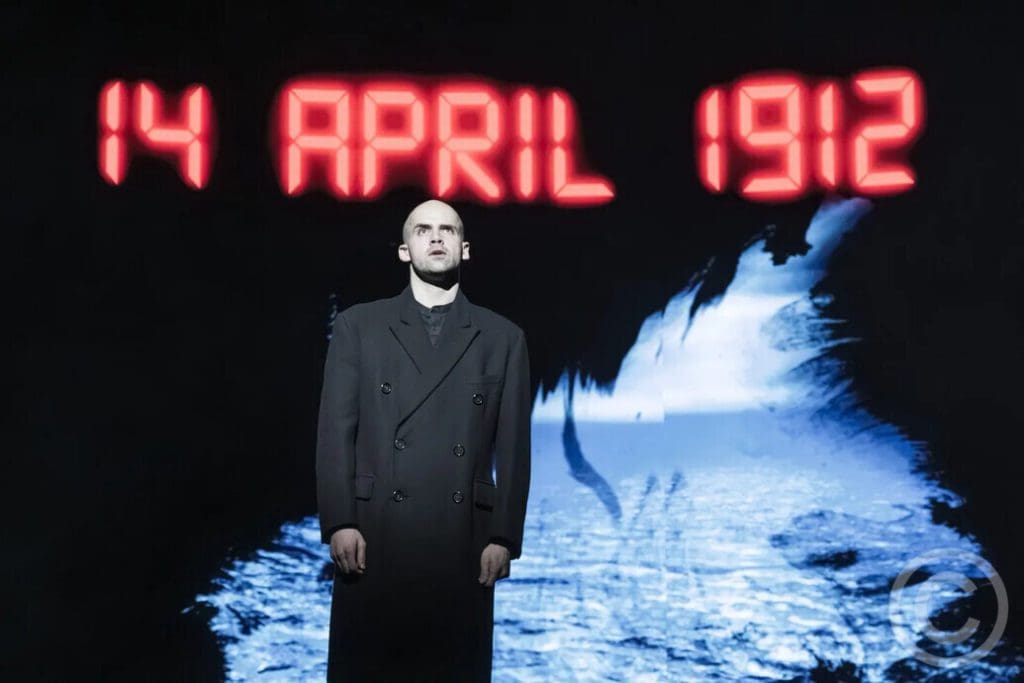
Depths of despair: Ralph Davis’s Hamlet in the Royal Shakespeare Company’s Hamlet, docking at York Theatre Royal from April 14 to 18. Picture: Marc Brenner
THE Royal Shakespeare Company’s visit to York Theatre Royal with Rupert Goold’s production of Hamlet, set on a sinking ship, will coincide with the 114th anniversary of RMS Titanic’s demise on the night of April 14-15 in 1912.
Around 1,500 people perished at sea that night from the estimated 2,240 on board. Death stalks Shakespeare’s tragedy too, Polonius, Ophelia, Rosencrantz, Guildenstern, Queen Gertrude, Laertes, King Claudius and Hamlet himself joining his already dead father, King Hamlet.
“Hamlet is a play about the inevitability of death: the death of fathers, the death of kings, the mortality facing each and every one of us, but it is also a play about how to live, what makes a good life and a just one too, however brief our allotted time,” says Goold.
“Our production is set aboard a ship but one that is soon to founder, going down with all hands,” says Goold. “Its inspiration comes from the most famous sinking in history, and just as that icy tragedy came to pass in a little over two and a half hours, our play takes place in real time and for about as long, as much catastrophic thriller as poetic meditation. It’s a production that asks what it means to be human and decisive when time is running out.”
Among those joining Ralph Davis’s Hamlet in Goold and revival director Sophie Drake’s touring cast in Shakespeare’s epic family drama of deceit and murder is Royal Shakespeare Company regular Ian Hughes in the roles of King Hamlet’s Ghost and the Player King.
From April 14 to 18, he will be returning to York Theatre Royal, 38 years since he made his professional debut in the 1988 pantomime Peter Pan, in the days when Frank Barrie played the dame. “Frank had made his debut there too in 1959 in Henry IV, Part 2, the play that marked my debut for the RSC in the 1990s – and I’ve learned that Frank had played Hamlet at the Theatre Royal in [March] 1974,” says Ian.

Ian Hughes, front, in the Royal Shakespeare Company’s Hamlet. Picture: Marc Brenner
“In another Yorkshire connection, Harrogate Theatre artistic director Andrew Manley saw me in Peter Pan and said afterwards, ‘do you fancy joining my Harrogate rep company?’. “I was a Kit Kat Girl in Cabaret; we also did Mrs Warren’s Profession, the regional premiere of Caryl Churchill’s Serious Money, Alan Bennett’s Forty Years On and the panto.
“Because I didn’t go to drama school, those Harrogate shows with Andrew were effectively my drama school after starting with the Theatre Royal panto, when I played John Darling, the boy with the top hat and the round glasses – and we got to ‘fly’!
“The Theatre Royal was beautiful, and it was so lovely to play there, when Frank made me so welcome. He was marvellous, dry-humoured company with his wonderful anecdotes of who he had worked with as an actor from an earlier time, when he had performed with [Laurence] Olivier.”
Ian was born in the South Wales Valleys, growing up in Merthyr Tydfil and joining the National Youth Theatre of Wales at 16 to work under director Alan Vaughan Williams, who nurtured the talents of Rob Brydon, Michael Sheen and Ruth Jones too. “Alan took no prisoners, treating us like professionals,” he recalls. “It was invaluable for me. I loved it.”
Only seven years later, Ian would be understudying Kenneth Branagh’s Hamlet in Adrian Noble’s production at the RSC. “I was 23, so I have a long connection with the play. I had to learn every line of the Second Quarto version, which runs to more than four hours [making Hamlet the role with the most lines in Shakespeare’s 37 plays] – and I never went on once!
“Kenneth kept saying ‘people are flying in to see me, I have to go on’, so I never had the chance, despite learning all those lines.”

That sinking feeling: The Royal Shakespeare Company staging Hamlet on a ship in 1912. Picture: Marc Brenner
Instead, Ian had to content himself with playing Polonius’s servant Reynaldo and Fortinbras. “Part of the reason that I joined the RSC was because I’d just won the inaugural Ian Charleson Award for my [title] role in Johann Wolfgang von Goethe’s Torquato Tasso at the Lyric Hammersmith,” he says.
“I didn’t know anything about the award. I got asked to go to the National Theatre and found I was up against Simon Russell Beale in the RSC’s Edward II, thinking ‘I’m just this young actor from South Wales’. I won £5,000 and was presented with the award by Sir Alec Guinness. What a wonderful start to a career.”
Ian has gone on to play multiple parts for the RSC, most recently appearing in The Merry Wives Of Windsor two summers ago. Now he returns as the Ghost and Player King. “These parts appealed to me as a character actor,” he says. “I thought, ‘I fancy a go at these’, because of the interest in Hamlet, and the short tour appealed too.”
Analysing the impact of setting Hamlet on a ship,” Ian says. “In a nutshell, it brings out the claustrophobia. That exacerbates Hamlet’s feeling of frustration that he can’t escape. The sinking of the ship is effectively the metaphor of Denmark being a prison for Hamlet, and I think that works very well. Shakespeare’s plays are open to reinterpretation, and this reinterpretation is very powerful, with all its technical accomplishments too.
“Because Hamlet has so many water and sea references, you could be drowning in the play.”
Royal Shakespeare Company in Hamlet, York Theatre Royal, April 14 to 18, 7pm plus 1.30pm, Thursday, and 2pm, Saturday. Box office: 01904 623568 or yorktheatreroyal.co.uk.
What a superb article!