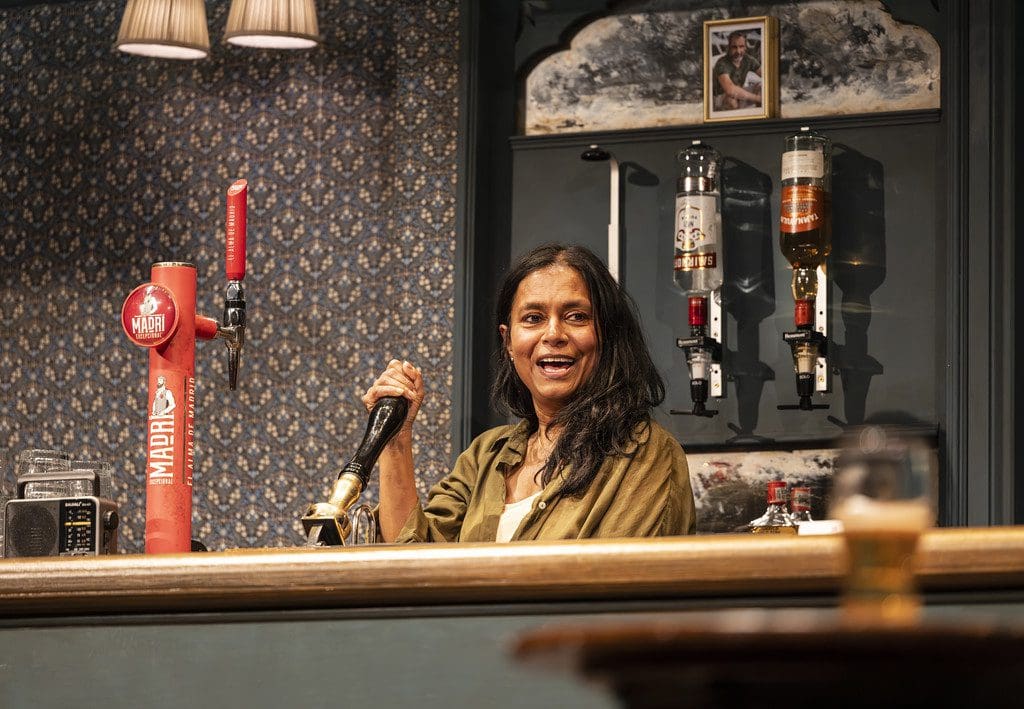
Bharti Patel’s Sanjana, landlady of The Albion in Our Public House. Picture: Pamela Raith
THE premiere of Our Public House, Barney Norris’s big-hearted story of community, connection and what might happen if everyone truly had their say, is running at Leeds Playhouse this week.
When an entire community spoils its ballot papers and refuses to vote, angry at being unheard but wanting to show those in power they will not to be taken for granted, a pub on the brink of closure becomes the only place left to talk in touring company Dash Art’s agitated agitprop drama.
As a storm rages outside, The Albion landlady Sanjana (Bharti Patel), a family in mourning, familiar regulars, unexpected guests and local Labour MP Mary (Gabriella Leon) are thrown together for a night of debate, confession and open-mic speeches.
In a town divided by politics, secrets spill. Songs rise. Jokes crackle. Ideals clash. People fall in love. People fall out. Something shifts.
Inspired by the real words of more than 600 people nationwide, Our Public House transforms the state of the nation into a play with original live music where “drama and voices like yours take centre stage”.
At every show, a local community ensemble will be part of the action onstage, performing alongside the cast and highlighting the issues they feel are most important locally. Hence no two performances will be the same on Dash Art’s tour that will take in Prescot, Coventry, Cornwall, Sheffield Playhouse (June 17 to 20) and London’s Marylebone Theatre
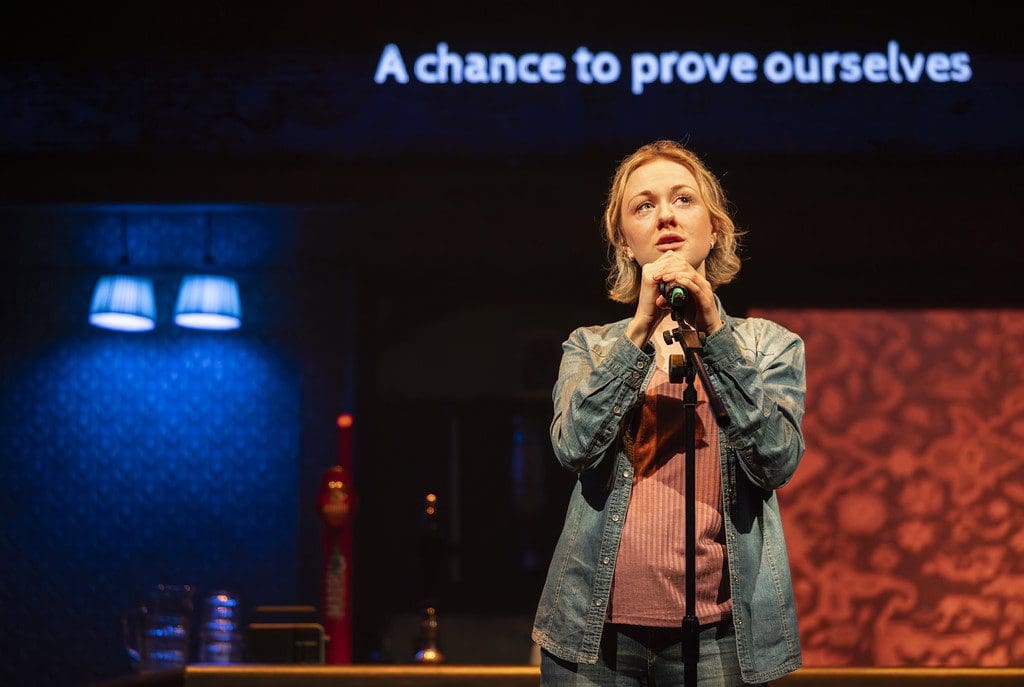
Lauren Moakes as released prisoner Jo in Our Public House. Picture: Pamela Raith
Told through spoken English, British Sign Language (BSL), Sign Supported English (SSE), creative captioning and with original live music, Our Public House considers what happens when your voices take centre stage and those with influence start to listen, as explored by Norris, who also wrote the book for Sting’s shipbuilding musical, The Last Ship.
Patel and Leon are joined in Josephine Burton’s cast of hearing and deaf actors by Kit Esuruoso, Chaya Gupta, Lauren Moakes and Fergus O’Donnell for a topical play created over three years of research and workshopping that integrates the words of people from across England – some of whom will appear on stage.
The Albion, such an evocative name for a divided state-of-the-nation play, is an emblematic setting, where landlady Sanjana is the fulcrum. “She is running a speechwriting club early doors in the pub, before punters come in for the open-mic night,” says Dash Art artistic director Josephine Burton. “She’s had enough of the people feeling that they’re not heard, so she’s teaching them how to write and deliver speeches.”
Dialogue is delivered alongside songs, composed by Jonathan Walton, with lyrics co-written by workshop participants from across the country. In addition, every night throughout the play’s run, the audience will hear two speeches written and delivered by local people.
“It will be a new ensemble every night. That’s amazing” says Josephine. “So, all the way down the line, the whole process is really dynamic, and it’s constantly changing and evolving.”
The politics and the pints come with a potent chaser of humour, served with meaty ideas too. “Dash Arts asks the big questions of our time and attempts to answer them over multi-year programmes of work, with artists, with academics, with participants, and with audiences,” says Josephine.

Chaya Gupta, left, Lauren Moakes, Kit Esuruoso, front, Fergus O’Donnell, Gabriella Leon and Bharti Patel in the Buller Buller Buller, Oy Oy Oy! scene in Our Public House. Picture: Pamela Raith
Post-Brexit, she detected a fracturing of British UK identity, stirring her interest in “who we are in England today. What does it mean to be English?”
Three years ago, that question prompted the beginning of a process wherein Dash Art became involved in a speech-writing project, fronted by academic Alan Finlayson, that aimed to help people make and deliver speeches on issues they cared about.
Or as Josephine puts it: “Things that they felt we could do today, that would make tomorrow better. And my instinct was, if we supported the project – went round the country, went into community centres, and deaf communities, and prisons, and schools, and worked with young activists in Sheffield, and in Coventry, and in Norwich, and in Cornwall, and in Prescot – we’d get a real picture of who we are as a country.”
Those early stages “coincided with the dying days of the last Conservative government”. “We were hearing people talk about cost of living, and mental-health crisis, and special-needs education, and social housing. I always knew we were gonna make a play of some sort. I just didn’t know what,” she says.
Inspiration struck when Josephine realised a local pub would best suit those conversations. It was at this point that she brought playwright Barney Norris on board – with source material aplenty to utilise.
“I read 125 speeches before my initial workshop, and it was up to 200 by the time I delivered the first draft – and it’s kept growing,” he says. “So it’s kind of been a continual live document. This is my fourth play set in a pub.
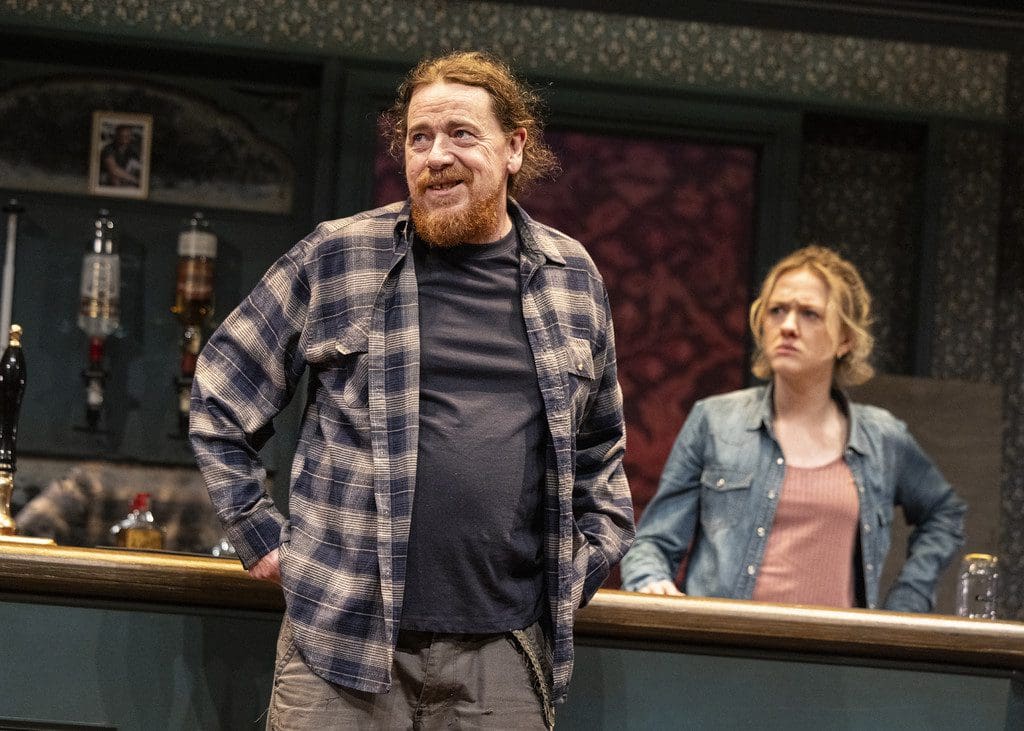
Fergus O’Donnell’s Scott: Pub regular standing for Reform in the local election in Our Public House. Behind the bar is Lauren Moakes’ Jo. Picture: Pamela Raith
“I love a pub play, because I think the complex dynamics of status, and home, and performance in those spaces, are wonderful metaphor territory – for society, and also the kind of toxicity and ‘exclusionary-ness’ of pubs to some people, and the concept of welcome, the concept of a place you’re allowed to go in and get a glass of water, and not spend any money. And all the best stories happen around the fires.”
The creative process with Dash Arts felt very natural for Barney. “It’s a really exciting collaborative culture clash,” he says. “We’ve sustained the social-realist context that’s the basis for the majority of my work, and then, from time to time, we’ve exploded it – with music, or the public getting up on stage and speaking. So the play feels like this interesting meeting place of styles and languages, in the same way that society, of course, is also a meeting place.”
A further influence was Shakespeare’s The Tempest. “Could the Albion be like Prospero’s island, and could our landlady be a version of Prospero, conjuring magic, bringing people into her world?” ponders Barney. “And we’re touring to Shakespeare North, which feels appropriate.”
Barney describes Our Public House as “a play that engages with big ‘P’ politics”. “That’s a real new frontier,” he says. “Obviously, all theatre is political, but I hadn’t done a play about a politician.”
Coincidentally, the playwright had decided to enter politics himself, standing for the Greens in his hometown of Salisbury in the 2024 General Election. “That was really fun – an opportunity to amplify the lessons and share them, because I never imagined a world in which I won the seat of Salisbury off the Tories,” he says.
“But what I could do was to try and learn lessons about that process and feed them into the wider discourse – and the play was so exciting in that context, a way to talk about all that.”
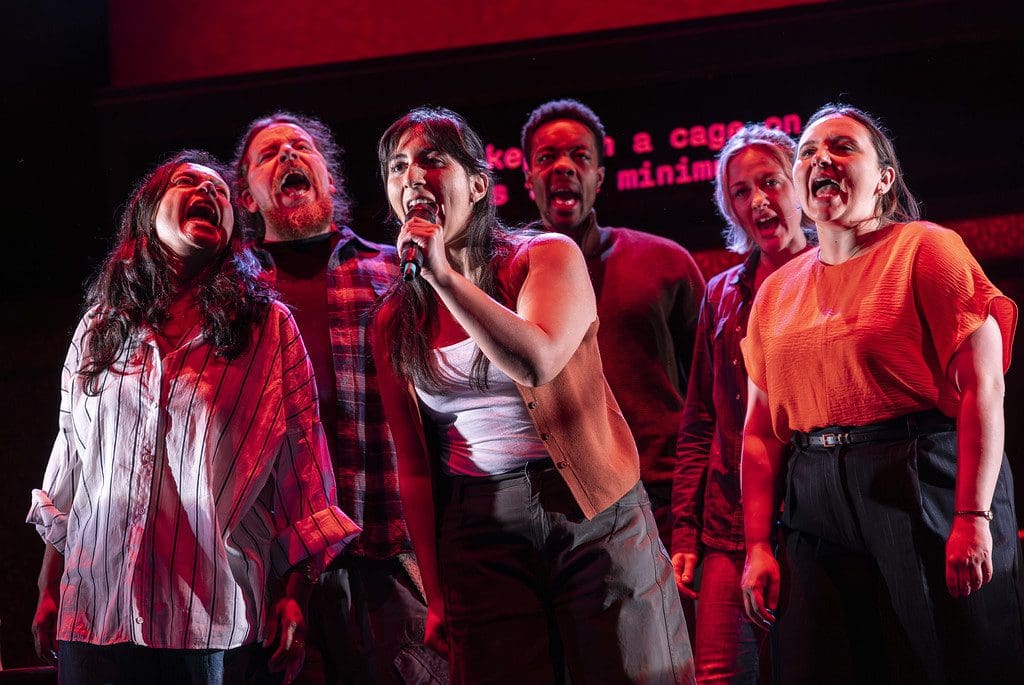
Chaya Gupta, centre, leading the singing in Our Public House with Bharti Patel, left, Fergus O’Donnell, Kit Esuruoso, Lauren Moakes, and Gabriella Leon. Picture: Pamela Raith
Given that political office might seem an unlikely career swerve for a playwright, Barney cheerfully admits that it was not particularly on his to-do list. “I did it partly because I’d been going along to the meetings of the local Green Party, and honestly, at that time, there were only two of us attending the meetings regularly who were still a working age.
“I’d only been in the area for a short time, so I wouldn’t normally have muscled in, but I thought, oh, go on. I’d love that. It was this amazing opportunity to tramp the streets and meet people. One of the secret privileges of it was that I revisited and reintegrated into the landscape of my youth, having not lived in Salisbury since I was 18. You come back, you’re walking down every street you’ve been drunk underage on in your life. It was great.”
More seriously, Barney was struck, both on the doorstep and on the hustings, by the way politicians “have to pretend to listen in order to get a vote, and they will sort of half-promise some stuff or whatever”.
“There’s an extraordinary fakeness around what they’re allowed to say,” he says. “For example, the Labour manifesto had just 85 words on their agricultural policy – and that was what the Labour candidate was allowed to say. He didn’t have any other insight, and couldn’t answer any specific question. That was really interesting: to see the limits of language, the straitjacket of what an individual politician is allowed by head office to say.”
As a writer, Barney relished the colour and flavour of the environment: the Reform candidate was openly an admirer of Putin, “which, in the city of Novichok, felt like a bold move,” he says.
Also standing for election was the king of the Druids, Arthur Pendragon. However, the most significant contribution to the play’s plot from Barney’s brief time in politics was the idea of a vote strike.
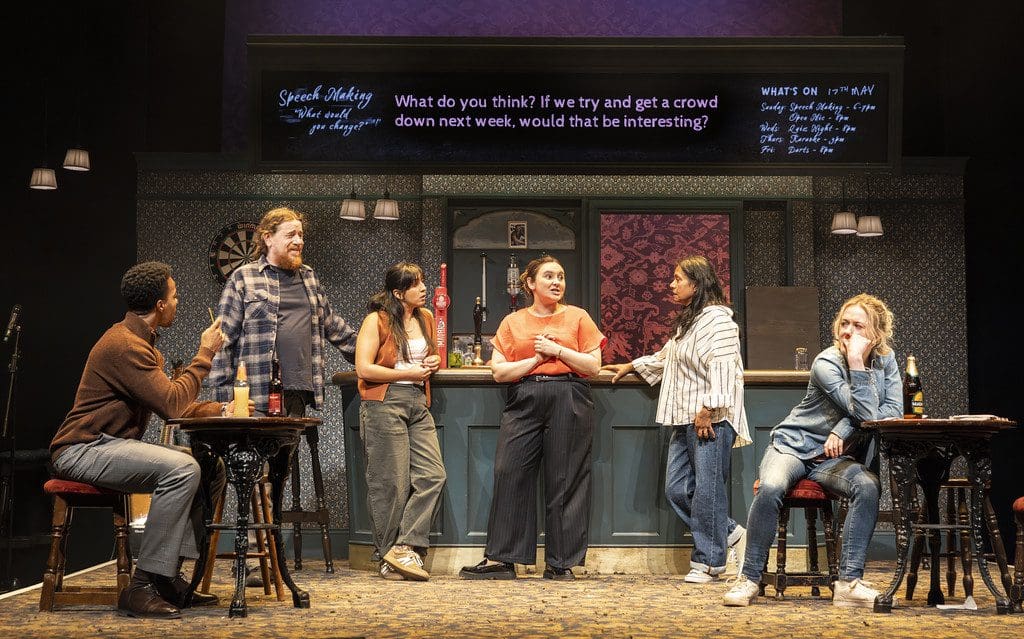
Gabriella Leon’s MP Mary holding centre stage in Our Public House. Picture: Pamela Raith
“On election night, you have to look at every single spoiled ballot, and collectively agree that they are spoiled, and that they shouldn’t be counted,” he says. “There were hundreds more than usual at the last election. Many of them were penises drawn on the ballot, which turned out to be a campaign organised by a local anarchist who worked in a bar.
“That felt arresting to me. I thought, well, there’s something in the water, isn’t there? The rage and rejection that people feel towards mainstream politics was there, in those endless daubings on the ballot paper.”
This is not, however, a symptom of disengagement, suggests Josephine. “People are incredibly inspirational. If you give them an opportunity to speak, everyone has ideas about what we could do that would make things better, but they don’t feel heard,” she says. “People feel politics is broken because the system does not enable change. It’s definitely not apathy.”
Key to the play’s vision is the central politician character, MP Mary, being deaf. “We spent time in the deaf community around the UK,” says Josephine. “It was so powerful to hear what they felt, and to be able to provide a platform for those feelings and thoughts to be expressed. It was important for us to bring a deaf actor into the room alongside a hearing cast.”
Actress Gabriella Leon “helped us and gave us permission to build a deaf character,” says Josephine. “That the politician in our play is deaf lends some irony to the fact that she is the first person to listen to the voices of the local community.”
The creation of Our Public House has been rich in its variety of lived experience. “The work that we’ve done in prisons has been unbelievable,” says Josephine, after company members visited HMP Styal, a women’s prison just outside Manchester.
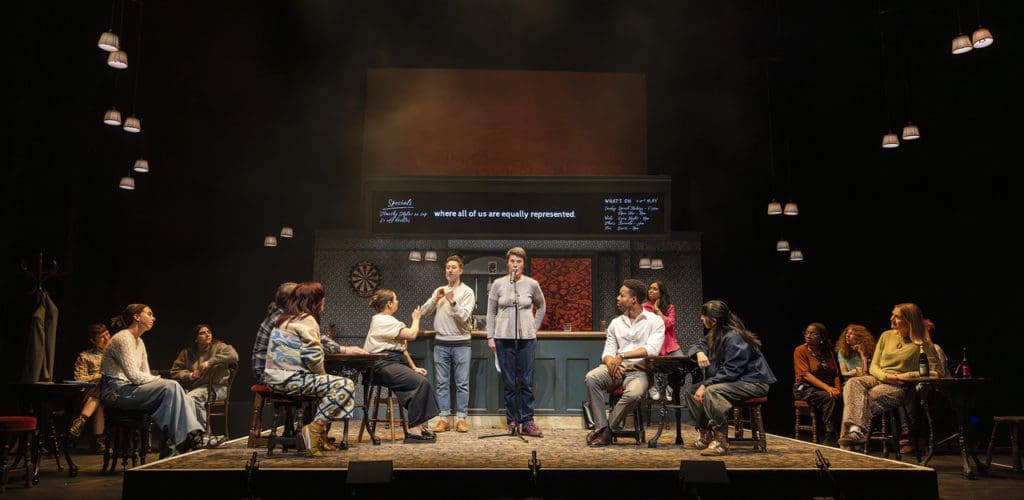
The “community ensemble” supporting cast changes at every performance of Our Public House to represent differing voices from the public. Picture: Pamela Raith
“My heart went out for the women in the room, and they have inspired one of the characters in our play. These are people who are so silenced in society. It was very moving.”
For Harvey, creating the character of a putative Reform councillor was among his most invigorating challenges. “The arc of political zeitgeist across the period that we’ve been making the show has mirrored the journey we’ve been on with that,” he says.
It was essential to avoid approaching the character “from a place of demonisation and snobbery and dismissal,” he posits. “It’s such an incredibly prominent element of our contemporary politics. So I’ve really tried to articulate that empathetically from the inside out.
“My process of writing is very much to ‘be’ the characters, and I write out loud with my mouth, and then I write it down later. I just wander around the fields, talking to myself in their voice until they’re funny, you know?
“And so, to become that person – coming from the modern urban Left – that felt like a stimulating adventure. I hope what we’ve done is write a person of great dignity and integrity, with real concerns and problems – but who is coming up with, to my mind, the wrong solutions for them.”
Both Josephine and Barney emphasise that Our Public House should not feel like a lecture. “It’s just really, really funny,” she says “It’s a comedy. A really good night out.” Crucially, it is relatable too. “It’s a play about everywhere. Your place. Your local.”
Dash Art in Our Public House, Leeds Playhouse, tonight, 7.45pm; tomorrow, 2.30pm & 7.45pm. Box office: 0113 213 7700 or leedsplayhouse.org.uk. Sheffield Playhouse, June 17 to 20; sheffieldtheatres.co.uk.
Feature by Sam Marlowe & Charles Hutchinson