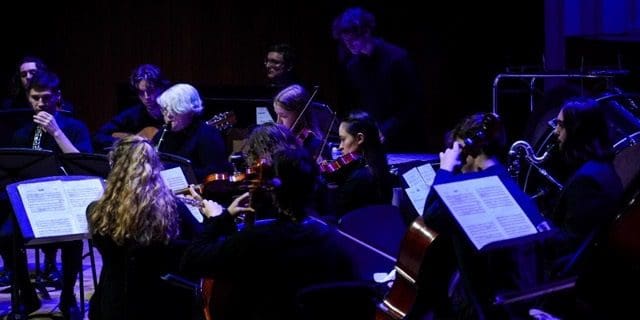
The Chimera Ensemble in concert at Sir Jack Lyons Concert Hall
LAST Friday evening’s concert was dominated by a performance of Julius Eastman’s 1974 work, Femenine, which, given that it lasted one hour plus, is hardly surprising.
Like the best of the minimalist music, I found the performance both hypnotic and radiant. The opening could be likened to that of a musical dawn, beginning with a simple rhythmic figure – semiquaver groupings coupled with a syncopated two-note motif – on vibraphone, inviting the other instruments to join in.
It felt like the players were given freedom – when to come in, how long to repeat material – and this created a fluid, floating quality. This distinguished the effect from the stricter processes of Philip Glass or Steve Reich, in both feel and structure.
The resulting sensual quality may, in part, help explain Eastman’s choice of title, Femenine. As a Black and openly gay composer working outside the classical mainstream, questions of identity and expression inevitably inform how the work is heard.
In the opening section, the instruments don’t simply join in; they overlap, blurring any clear dialogue, harmony or any sense of hierarchy. Yet there was drama, albeit one without a fixed direction. About halfway through, the music kind of disintegrates. Here it becomes fragile, dislocated, vulnerable. As I didn’t see it coming, the effect was striking.
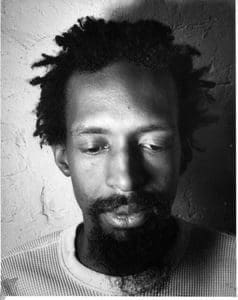
Composer Julius Eastman
The return journey, although covering similar ground – the rhythmic heartbeat still anchoring the music – felt altered, transformed. Drama was further enhanced by the alignment of clear tonal (simple triads) interruptions, signalled by the pianists Catherine Laws and Felix Edwards-McStay.
The locking-in of these tonal events gave the work moments of both clarity and radiance. The ending – a winding down leaving only the vibraphone’s rhythmic heartbeat gently laid to rest – was exquisite.
It would be wrong to single out any of the individual performers – it just isn’t that sort of experience – but credit should go to performance director Catherine Laws, and to percussionists John Rousseau (vibraphone) and Peter Evans (marimba) for their stamina and utterly infectious enthusiasm.
Mercifully, the first half was a short affair, showcasing three works by the university music department’s student composers.
Now then, back in the day – OK, my day – showcasing student compositions meant indecipherable programme notes explaining the unexplainable, accompanied by a performance experience of extremely loud, piercingly dissonant sounds designed toshatter the listeners’ teeth.
I enjoyed Sidney Wood’s Interruptions for solo electric guitar. It opened in a melancholic, reflective mood, but one without a melody or songline to follow. The “interruptions” were sudden distorted attacks with feedback that not only undermined the flow but also continually invited disorder and improvisation.
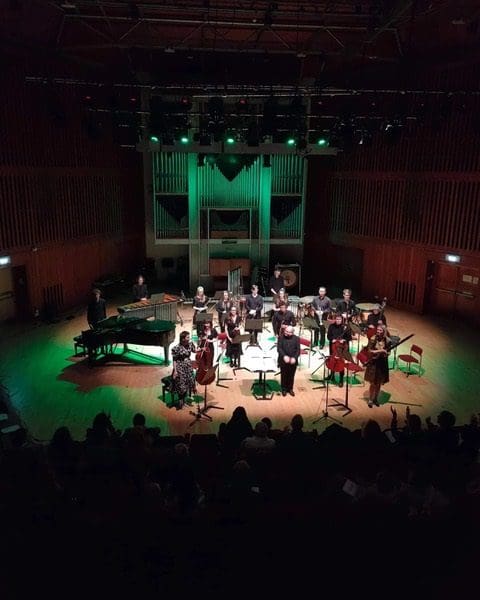
The Chimera Ensemble: Taking a bow at Sir Jack Lyons Concert Hall
To be sure, “harmonic saturation” enriched the sound world, and the interruptions added drama, but they also set up an expectation of virtuosic release. Just to be clear, I wasn’t expecting the piece to go full Pete Townshend, but certain expectations come with it: electric guitar solo = rock music = (some sort of) rebellion. Still, as I said, I enjoyed it.
I also enjoyed Manlu Du’s Landscape – for a pianist and their friend, although I wasn’t entirely convinced by it. There were lovely moments: the opening exchange of gentle clusters between the two performers (Roy Watkins and Manlu Du), and a simple piano pattern delicately distorted by the second pianist – the “friend” – dampening the strings, for example.
However, the second pianist’s movement around the spacedidn’t add anything meaningful, and the use of two pianos weakened the intended intimacy.
Now I’ve never heard of Brian Kernighan nor, mercifully, read his A Tutorial to the Language B, but I thought Danny Saleeb’s Hello World – based on the (simple) computer programme – was inspired.
Arthur Elliott’s performance on solo viola gave the impression of an unfolding landscape. The opening texture was one of fragility created through a range of extended string techniques: sul ponticello (bowing close to the bridge, creating a glassy, metallic quality); sul tasto (bowing over the fingerboard, harmonics), producing a purer, thinner tone and microtones – shifting, unstable ‘out of tune’ notes etc.
Saleeb uses these to create fascinating, layered textures that feel distinctly otherworldly. I heard traces of folksong and even Bach – arpeggiation, implied counterpoint – peeping through the surface. A short but inventive and musically intelligent work, and technically demanding. Full credit to Arthur Elliott. This was by far the standout work of the first half, and Danny Saleeb is clearly a composer to watch.
Review by Steve Crowther